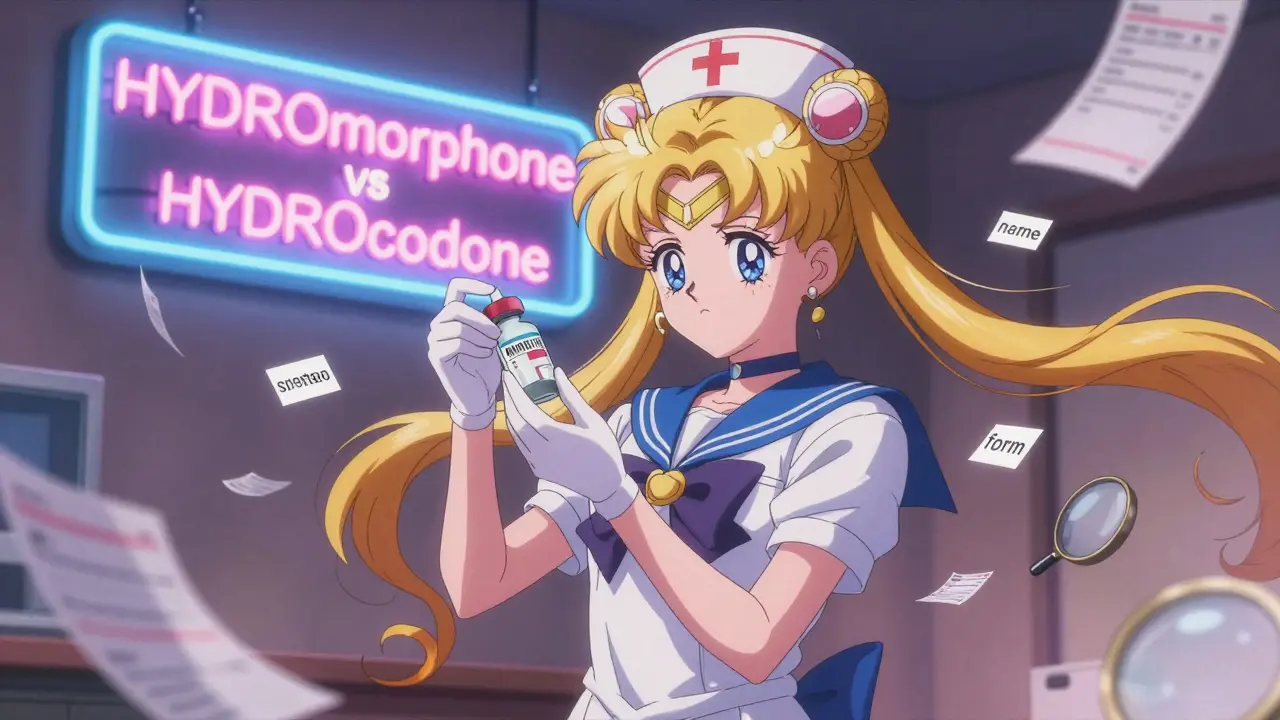
Every year, over 1.5 million people in the U.S. suffer preventable harm from medication mistakes. Many of these errors happen because someone didn’t check the medication name, strength, or dosage form carefully enough. It’s not always a pharmacist’s mistake or a doctor’s typo. Sometimes, it’s a nurse rushing between rooms, a patient misreading a label, or a caregiver assuming a pill looks familiar. But these aren’t just accidents-they’re preventable. Here’s how to check medication details safely, every single time.
Start with the Medication Name
The first thing you need to verify is the actual name of the drug. Sounds simple, right? But look-alike and sound-alike names cause thousands of errors each year. Think about prednisone and prednisolone. They’re almost identical in spelling and pronunciation, but they’re not interchangeable. One is for inflammation, the other for autoimmune conditions. Mixing them up can lead to serious side effects.Always compare the name on the prescription to the name on the bottle or package. Don’t rely on memory. Use Tall Man lettering-a technique where key differences are capitalized to make them stand out. For example, HYDROmorphone vs. HYDROcodone. Many electronic systems now auto-format names this way, but paper prescriptions don’t. If you’re handwriting or reading a handwritten note, add those caps yourself.
Watch out for abbreviations. “MS” could mean morphine sulfate or magnesium sulfate. “U” for units can be mistaken for “0” or “cc.” Always spell out “units,” “micrograms,” and “milligrams.” The FDA and ISMP banned these abbreviations years ago, but they still show up. If you see one, stop. Ask for clarification.
Verify the Strength-Every Single Time
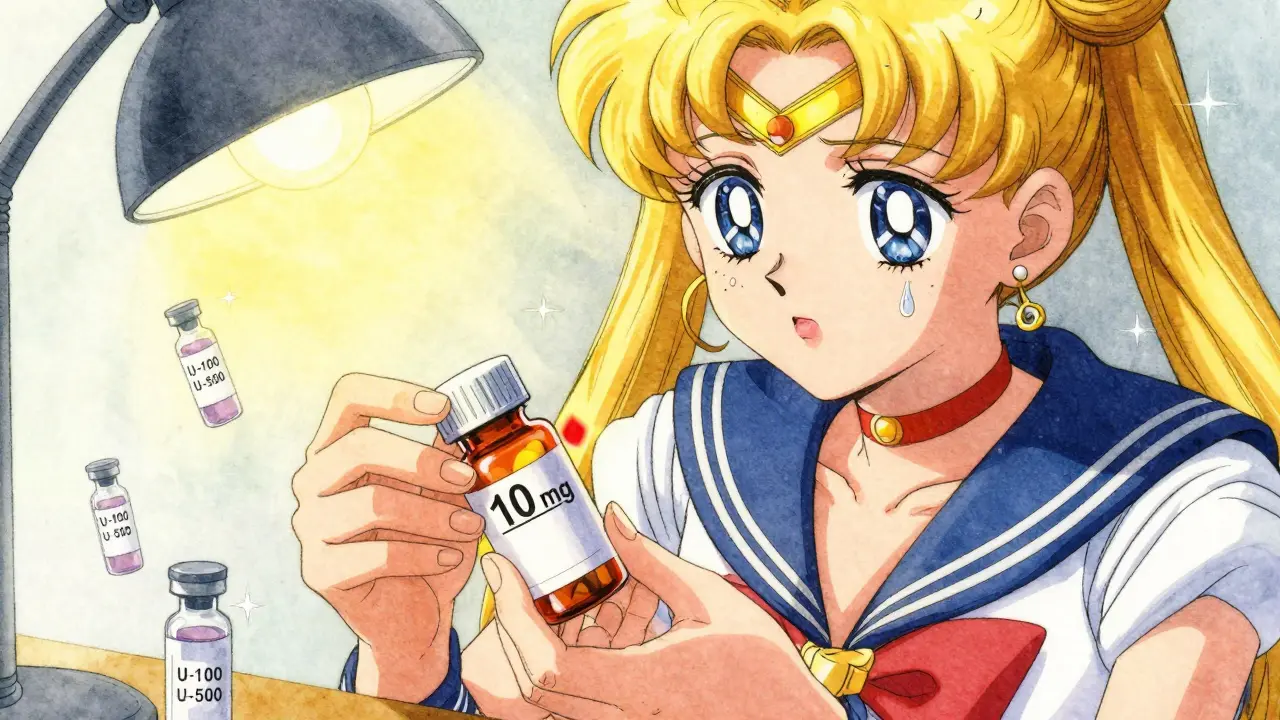
Strength is where most mistakes happen. A 2018 FDA report found that 34% of medication errors involved wrong strength. That’s more than one in three. A common example? Insulin. One vial might be U-100 (100 units per mL), another U-500 (500 units per mL). Give the wrong one, and you risk a deadly overdose.Always check the number and the unit together. Don’t just read “10.” Read “10 mg.” Or “500 mcg.” Or “1000 units.” The unit matters as much as the number. Writing “10mg” without a space is dangerous. It can look like “100 mg” if the “g” smudges. The ISMP says adding a space-“10 mg”-reduces errors by 12%.
For liquid medications, pay attention to concentration. Is it 5 mg/mL? Or 50 mg/mL? That’s a tenfold difference. If the prescription says “5 mg” but the bottle says “50 mg/mL,” you need to calculate how much to draw. Never guess. Use a syringe with clear markings. If you’re unsure, ask a pharmacist to double-check the math.
Injectables are especially risky. Epinephrine, for example, comes in 1:10,000 (used in emergencies) and 1:1,000 (used for allergic reactions). The first is 0.1 mg/mL, the second is 1 mg/mL. Confusing them can kill someone. Always convert ratios to decimal concentrations: “1:10,000” becomes “0.1 mg/mL.” Write it that way on your notes.
Confirm the Dosage Form
The form of the medication tells you how to take it. Is it a tablet? A capsule? A liquid? A patch? A suppository? Giving a tablet meant to be swallowed as a chewable can cause choking. Giving a topical cream as an oral dose can poison someone.One Reddit user shared how a nurse almost gave an oral insulin tablet to a patient who needed an injection. The tablet was labeled “insulin,” but the form was missing from the order. The nurse caught it because she checked the vial against the order. That’s the power of verification.
Look at the label. Does it say “oral suspension”? “Extended-release tablet”? “Transdermal patch”? If it doesn’t match what was prescribed, don’t give it. Even if the name and strength are right, the form can change everything. A sustained-release tablet crushed into a smoothie will release all its drug at once-potentially causing overdose.
High-alert medications like heparin, insulin, and opioids need extra attention. In a 2023 Mayo Clinic case, using a “four-eyes” rule-two people check the medication before giving it-cut errors by 94%. That’s not overkill. It’s necessary.
Check at Three Critical Points
You don’t verify once. You verify three times:- When you receive the order-Did the prescriber include the full name, strength, form, route, and frequency? If any part is missing, stop. Don’t guess. Call for clarification.
- When you prepare the medication-Compare the prescription to the physical drug. Read the label on the bottle or package. Match name, strength, form. If you’re using a blister pack, check each pill individually.
- Right before you give it-Confirm the patient’s name, date of birth, and medication details one last time. Use the “read-back” method: say aloud, “I’m giving Mr. Jones 5 mg of lisinopril, oral tablet, once daily.” Ask the patient to repeat it back if they’re alert. It’s simple, and it works.
A 2022 study found that nurses who used the read-back method prevented 89% of potential errors. That’s not luck. That’s discipline.
Watch for Red Flags
Some signs mean something’s wrong:- The strength doesn’t match the usual dose (e.g., 500 mg of amoxicillin for a child).
- The dosage form is unusual (e.g., a liquid antibiotic prescribed as a tablet).
- The route doesn’t match the form (e.g., a patch labeled for oral use).
- The prescription has abbreviations like “QD,” “U,” or “μg.”
- The label is blurry, poorly printed, or missing key info.
If you see any of these, pause. Don’t rush. Ask. Double-check. The system isn’t perfect. Your eyes and brain are your last line of defense.
Use Technology, But Don’t Trust It Blindly
Most hospitals and pharmacies use barcode scanners and electronic systems. These help. Epic and Cerner systems flag look-alike names and calculate doses automatically. Barcode scanning cuts dispensing errors by 83%.But technology can fool you. A 2020 study found that 18% of errors happened because clinicians ignored warnings because the system approved the order. This is called “automation bias.” If the screen says “OK,” you might skip the real check.
Always verify the physical product-even if the computer says it’s right. A barcode can be misapplied. A label can be swapped. A system can glitch. Trust but verify.

Training and Culture Matter
Hospitals that train staff for 4 hours initially and hold 30-minute refresher sessions every quarter cut medication errors by 63%. That’s not because the staff became geniuses. It’s because they built a habit.It’s not just about rules. It’s about culture. If people are afraid to speak up, mistakes happen. If nurses feel rushed, they skip steps. If pharmacists are overworked, errors slip through.
Speak up. Ask questions. Say, “Can we double-check this?” That’s not being difficult. That’s being safe. The American Society of Health-System Pharmacists says every order must include drug name, strength, form, route, and frequency-and be verified at all three points. That’s the standard. Don’t settle for less.
What If You’re a Patient or Caregiver?
You don’t need to be a professional to keep yourself safe. Here’s what you can do:- Ask your pharmacist: “What is this medicine for? What’s the strength? How do I take it?”
- Take a photo of the prescription and the bottle. Compare them side by side.
- Use a pill organizer with clear labels. Write the name, strength, and time on each slot.
- If you’re giving meds to someone else, have another person check before you give it.
- Never assume. Even if you’ve taken this pill before, check the label. Manufacturers change packaging. Strengths change. Formulations change.
One nurse in Bristol told me how her mother almost took a 100-fold overdose of heparin because the label said “5,000 units/mL” but the order said “50 units/mL.” She caught it because she read the bottle out loud. That’s all it took.
Final Thought: Slow Down to Speed Up
It takes extra time to check every name, strength, and form. But it takes far less time than dealing with an overdose, a hospital stay, or a lawsuit. Medication safety isn’t about perfection. It’s about consistency. It’s about asking the same questions, every time, no matter how busy you are.The tools are there. The guidelines are clear. The data proves it works. What’s missing is the habit. Build it. Protect yourself. Protect others.
What’s the most common mistake people make when checking medication?
The most common mistake is skipping the strength check. People assume they know the dose because they’ve taken the drug before. But strengths change. A 10 mg tablet isn’t the same as a 100 mg tablet. Always read the number and the unit together-never just the number.
Why are spaces between numbers and units so important?
Writing “10mg” without a space can be misread as “100 mg” if the “g” looks smudged or faded. The ISMP found that adding a space-“10 mg”-reduces this type of error by 12%. It’s a tiny change with a huge impact.
Can I trust the barcode on the medication bottle?
Barcodes help, but they’re not foolproof. Labels can be misapplied, scanners can malfunction, and systems can glitch. Always cross-check the physical label with the prescription-even if the scanner says it’s correct. Your eyes are still the best tool.
What should I do if I see an abbreviation like “U” or “MS” on a prescription?
Stop. Don’t proceed. “U” can mean units, but it’s easily confused with “0.” “MS” could mean morphine sulfate or magnesium sulfate. Ask the prescriber to rewrite it fully: “units” or “morphine sulfate.” Never guess.
Is it safe to crush a tablet if I can’t swallow it?
Only if the label or pharmacist says it’s safe. Many tablets are extended-release or enteric-coated. Crushing them can release the full dose at once, causing overdose or stomach damage. Always check the dosage form before altering it.
If you’re a healthcare worker, make verification a ritual-not a chore. If you’re a patient, never be afraid to ask. Medication safety isn’t just a policy. It’s a promise. And it only works when everyone takes it seriously.
Ed Di Cristofaro
February 1, 2026 AT 05:09People still mix up prednisone and prednisolone? Bro, that's like confusing a hammer with a screwdriver and then blaming the tool. If you can't tell the difference between two drugs that sound like siblings, maybe you shouldn't be handling pills at all.
vivian papadatu
February 2, 2026 AT 01:43This is one of those posts that should be printed and taped to every pharmacy counter, nurse station, and kitchen table. I've seen too many families panic because someone assumed the pill looked familiar. Always read the label. Always. No exceptions.
Nicki Aries
February 3, 2026 AT 02:03I work in a nursing home, and I can't tell you how many times I've caught a near-miss because I paused and read the label out loud. One time, a family member brought in a bottle labeled 'insulin'-but it was a tablet. I asked the pharmacist to verify. She said, 'Thank God you caught that.' That’s why we do the three-point check. It’s not bureaucracy-it’s survival.
And yes, spaces matter. '10mg' looks like '100mg' when you're tired. I make my staff write it as '10 mg' in bold. No exceptions. No shortcuts.
Also, if you're giving meds to someone who can't read, don't just hand them the bottle. Sit with them. Point to the name, the number, the form. Make it visual. People remember what they see, not what they're told.
And for the love of all that's holy, stop using 'U' for units. It's 2025. We have keyboards. Type 'units.' It takes two seconds. Two seconds could save a life.
My grandmother almost died because a nurse gave her 'MS' and meant morphine. It was magnesium. She went into cardiac arrest. Don't be that person.
Verification isn't a chore. It's a promise you make to someone who trusts you with their life.
And if you're a patient? Ask. Again. And again. You have every right to know what you're taking. No one will think you're annoying. They'll think you're smart.
One more thing: if the label is blurry? Don't guess. Call the pharmacy. Send a photo. Wait. It's worth it.
Medication safety isn't about being perfect. It's about being consistent. And consistency? That's a habit. Build it. Like brushing your teeth. Every. Single. Time.
Naresh L
February 3, 2026 AT 20:46It’s interesting how we rely on systems designed by humans to prevent errors caused by humans. The real issue isn’t the labels or the abbreviations-it’s the pressure to move faster than care allows. In India, we often don’t have barcode scanners, but we have elders who’ve seen decades of medicine. They teach us: ‘Slow down. Read twice. Ask once.’ Simple. Human. Effective.
Sami Sahil
February 5, 2026 AT 06:42bro i used to work in a pharmacy and i saw a guy try to give a kid 100mg of amoxicillin bc the script said '100' and he forgot the 'mg' part. kid was 3. we saved him but man… just read the damn thing. spaces matter. units matter. your laziness ain't worth a life.
franklin hillary
February 6, 2026 AT 04:35Barcodes are nice. But the human eye is still the most accurate scanner we’ve got. I’ve seen systems approve wrong meds because the label was swapped. The machine didn’t care. The nurse did. That’s why I always do the triple check-even if the screen says 'all good.' Trust, but verify. Always.
And if you’re a patient? Don’t be shy. Say, 'Can you read it back to me?' Most pros will respect you for it. The ones who don’t? They’re the ones who need the training.
Bob Cohen
February 6, 2026 AT 06:45Wow. Another 'just read the label' lecture. Did you also write a 3,000-word essay on why you should tie your shoes? Some of us are working 12-hour shifts with 30 patients and no time to spell out 'micrograms.' The system is broken. Blaming the nurse for a typo is like blaming the cashier for the ATM eating your card.
Ishmael brown
February 6, 2026 AT 13:47Let’s be real-this whole 'check three times' thing is just corporate propaganda. The real problem? Pharma companies change packaging every 6 months to confuse everyone. I’ve seen the same drug with three different labels in one pharmacy. It’s not human error. It’s designed chaos. And the FDA? They’re in the pocket of Big Pharma. You think they want you to be safe? Nah. They want you to keep buying pills.
And those 'four-eyes' rules? That’s just to keep you busy so you don’t notice the real scam.
Aditya Gupta
February 7, 2026 AT 19:15in india we dont have fancy scanners but we have mom and dad checking every pill. if label says '5mg' and bottle says '50mg' we ask. no shame. life is more important than speed. simple.
Nancy Nino
February 9, 2026 AT 11:42While I appreciate the sentiment behind this post, it is imperative to note that the cultural and socioeconomic disparities in healthcare access render such procedural recommendations largely inaccessible to marginalized populations. The notion that 'just asking' is sufficient ignores systemic barriers to patient advocacy. Furthermore, the reliance on 'read-back' methods presupposes cognitive and linguistic competence, which is not universally present. A more equitable approach would involve standardized, multilingual, pictographic labeling systems-implemented by regulatory bodies, not left to individual vigilance.
June Richards
February 10, 2026 AT 19:07Ugh. Another 'read the label' post. Newsflash: I’m not a pharmacist. I’m a single mom working two jobs. I don’t have time to spell out 'micrograms.' And yeah, I’ve given my kid the wrong dose before. So what? I didn’t kill them. Maybe stop lecturing and fix the system instead of blaming the people trying to survive it.
Jaden Green
February 12, 2026 AT 12:17It’s fascinating how this post reduces a complex, multi-layered systemic failure-rooted in pharmaceutical monopolies, underfunded healthcare infrastructure, and the commodification of human life-into a simplistic checklist. You blame the nurse for misreading 'U' as '0,' but you ignore the fact that the FDA only banned 'U' in 2006, and even now, legacy systems still use it. You want people to 'verify every time'? Fine. But why are we relying on exhausted, underpaid workers to patch holes in a collapsing dam? The real failure isn’t human error. It’s institutional negligence dressed up as personal responsibility.
And don’t get me started on the 'four-eyes' rule. That’s not safety. That’s liability padding. Hospitals love it because it shifts blame. If two people miss it, who’s accountable? No one. The system wins. Again.
Stop asking patients to be pharmacists. Fix the damn labels.
Lu Gao
February 13, 2026 AT 02:33Love this! 👏 I always take a pic of my meds and the script side by side. One time I caught a 10x difference in insulin concentration because the bottle said '500 units/mL' but the script said '50'. I called the pharmacy. They apologized and sent a new one. I’m not a doctor, but I’m not dumb either. 😊
Angel Fitzpatrick
February 15, 2026 AT 00:20They don’t want you to know this, but the entire medication verification system is a front. The real danger? The RFID chips embedded in pill bottles. They’re not for tracking. They’re for surveillance. Every time you scan a barcode, your biometrics get logged. Your insulin use? Your blood pressure trends? All fed into a global algorithm that predicts your 'health risk profile.' That’s why they push 'read the label'-to make you think you’re in control. You’re not. You’re a data point. And the 'four-eyes rule'? That’s just to ensure two people see your data before it gets sold to insurers.
They’re not trying to prevent errors. They’re trying to prevent you from realizing you’ve been turned into a commodity.
Don’t trust the label. Don’t trust the scanner. Don’t trust the system. Trust nothing.
Nidhi Rajpara
February 16, 2026 AT 19:57Thank you for this comprehensive guide. I have noticed that in rural India, many caregivers rely on visual cues to administer medication, which is inherently risky. I have personally advocated for the use of color-coded pill organizers and pictorial instructions, which have shown remarkable improvement in adherence and safety. The key lies in education, not just regulation.
Ed Di Cristofaro
February 18, 2026 AT 04:46And yet, here we are. Still reading labels. Still asking questions. Still saving lives one stupid, boring, 10-second check at a time. You’re welcome, world.