
When your thyroid-stimulating hormone (TSH) is high but your free T4 is normal, you’ve got subclinical hypothyroidism. It’s not overt thyroid disease - no weight gain, no crushing fatigue, no dry skin yet. But that doesn’t mean it’s harmless. Millions of people in the U.S. alone are told their TSH is "borderline" - and then left wondering: should I take a pill? Or just wait and see?
What Exactly Is Subclinical Hypothyroidism?
Subclinical hypothyroidism (SCH) means your pituitary gland is working overtime. It’s pumping out more TSH because your thyroid isn’t producing enough T4 - just barely enough to stay in the normal range. Think of it like a car’s check engine light: the engine still runs, but something’s off. The key diagnostic criteria? Two separate blood tests, taken 2-3 months apart, showing TSH above the lab’s upper limit (usually 4.12 mIU/L) with free T4 still normal.
This isn’t rare. Around 1 in 5 adults over 60 have SCH. In younger people, it’s less common, but still affects 4-8% of the population. The real question isn’t whether you have it - it’s whether you need to treat it.
When Does TSH Actually Need Treatment?
Here’s where things get messy. Different guidelines say different things. The American Thyroid Association says: treat only if TSH is above 10 mIU/L. The American Association of Clinical Endocrinologists says: think about treatment if it’s above 7 mIU/L. The Royal Australian College of General Practitioners says: don’t treat at all if TSH is under 10.
So what’s the truth? It depends on three things: your TSH number, your age, and your thyroid antibodies.
If your TSH is above 10 mIU/L, treatment with levothyroxine is generally recommended. Studies show clear benefits: lower risk of progressing to full hypothyroidism, better cholesterol levels, and reduced long-term heart strain. One Cleveland Clinic study found 70% of people with TSH over 8 mIU/L ended up with TSH over 10 within four years - meaning their thyroid was slowly failing.
But what if your TSH is between 5 and 10? That’s the gray zone. For most people here, treatment doesn’t improve energy, mood, or weight. A 2017 JAMA trial with 737 patients found no meaningful difference in quality of life after a year of levothyroxine. So if you’re 65 and your TSH is 7.5, and you feel fine? Probably don’t need a pill.
Thyroid Antibodies Change Everything
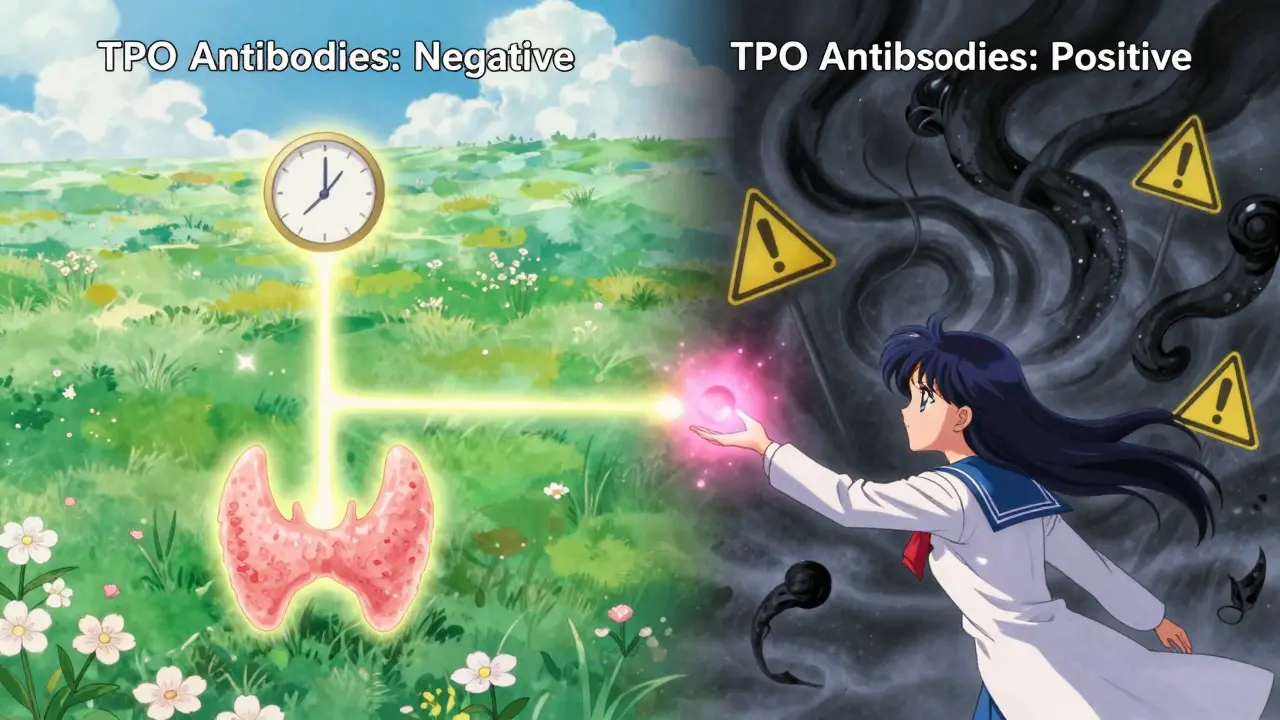
Here’s the game-changer: thyroid peroxidase (TPO) antibodies. If they’re positive, your immune system is attacking your thyroid. That’s Hashimoto’s disease - even if you don’t have symptoms yet.
Patients with positive TPO antibodies and TSH above 7 mIU/L have a 2.3 times higher chance of progressing to overt hypothyroidism. A 2020 study in Thyroid showed 32% of people under 50 with TPO antibodies and TSH between 7-10 saw symptom relief after starting low-dose levothyroxine. Fatigue lifted. Brain fog cleared. Cold intolerance improved.
If you’re under 50, have antibodies, and your TSH is above 7 - even if you feel okay - treatment is worth considering. It’s not about fixing symptoms today. It’s about stopping the slow burn before it becomes a fire.
Why Older Adults Should Be Careful
If you’re over 65, the risks of treatment often outweigh the benefits. A 2021 meta-analysis found a 12.3% higher risk of death in elderly patients treated for TSH under 10. Why? Because levothyroxine can overstimulate the heart. In older adults, even small doses can trigger atrial fibrillation, bone loss, or muscle weakness.
One patient I read about - a 72-year-old woman with TSH of 6.8 - started levothyroxine and developed irregular heartbeat within six months. Her doctor didn’t realize her heart was already at risk. That’s why guidelines now say: for seniors, watchful waiting is usually safer than medication.
What You Should Do Before Starting Medication
Don’t rush into levothyroxine. Get the full picture first.
- Test for TPO antibodies. This tells you if your thyroid is under immune attack.
- Check your lipids. High LDL cholesterol is a common early sign of thyroid underactivity.
- Assess heart health. If you have a history of arrhythmia or heart disease, treatment carries higher risk.
- Use a symptom scale. The 10-item Thyroid Symptom Rating Scale helps separate real thyroid symptoms from normal aging or stress.
Also, make sure your TSH test was done properly. TSH can spike after illness, stress, or sleep deprivation. If you’ve been sick or had a rough week, wait 4-6 weeks and retest.
How Treatment Works - And How Not to Mess It Up
If you and your doctor decide to treat, the starting dose is usually 25-50 micrograms of levothyroxine daily. That’s much lower than what’s used for full hypothyroidism (which often needs 75-125 mcg). The goal isn’t to crush TSH - it’s to gently nudge it back into the normal range.
Follow-up is critical. Check TSH every 6-8 weeks until it stabilizes. Then, twice a year. Too many people get a prescription and never go back. That’s how overtreatment happens - and that’s how you end up with a racing heart or brittle bones.
Also, watch your supplements. Iron, calcium, and even antacids can block levothyroxine absorption. Take your pill on an empty stomach, at least 30-60 minutes before food - and at least 4 hours away from supplements.
The Big Debate: Are We Overdiagnosing?
Some experts argue we’re turning normal variation into disease. The upper limit of "normal" TSH (4.12 mIU/L) was set decades ago based on a population that included people with undiagnosed thyroid damage. A 2022 study of 27,000 healthy people found the true upper limit for adults under 50 might be as low as 2.5 mIU/L. If we used that, nearly 1 in 4 young adults would be labeled with SCH.
And then there’s the money. A 2019 analysis in JAMA Internal Medicine estimated $1.2 billion is spent yearly in the U.S. on unnecessary levothyroxine prescriptions for SCH. That’s billions in pills, lab tests, and doctor visits for people who may never need treatment.
But here’s the flip side: under-treating someone who’s clearly progressing can lead to heart disease, infertility, or depression down the line. The goal isn’t to treat everyone. It’s to treat the right people.
What’s Next? The Science Is Still Evolving
The 2023 revision of the American Thyroid Association guidelines is expected to keep the TSH >10 threshold - but add a strong recommendation for treating younger patients (under 30) with TSH >7 and positive antibodies. The European Thyroid Association now uses "TSH velocity" - how fast your TSH is rising - to predict risk. If your TSH jumps by 1 mIU/L per month, your odds of progression double.
And the SHINE trial, a 5-year study tracking 1,000 people with TSH 4-10, will release results in late 2024. It’s the largest study ever to look at heart outcomes in subclinical hypothyroidism. We may finally get a clearer answer.
Bottom Line: Your Action Plan
So what should you do if your TSH is high but your T4 is normal?
- If your TSH is >10 mIU/L → Treat. Benefits outweigh risks for most people.
- If your TSH is 7-10 mIU/L and you’re under 50 → Test for TPO antibodies. If positive, consider treatment. If negative, monitor every 6-12 months.
- If your TSH is 7-10 mIU/L and you’re over 65 → Don’t treat unless you have clear symptoms and high cardiovascular risk. Watch and retest.
- If your TSH is 5-7 mIU/L → Monitor. No treatment needed unless you have strong symptoms and positive antibodies.
And always remember: feeling tired doesn’t automatically mean your thyroid is to blame. Stress, sleep, diet, and depression can mimic thyroid symptoms. Don’t assume. Test. Then decide.
Is subclinical hypothyroidism the same as Hashimoto’s?
No. Subclinical hypothyroidism is a lab finding: high TSH with normal T4. Hashimoto’s is an autoimmune disease - your immune system attacks your thyroid. Many people with Hashimoto’s start with subclinical hypothyroidism, especially if they have positive TPO antibodies. But not everyone with SCH has Hashimoto’s. Antibody testing is the only way to know.
Can I stop taking levothyroxine if my TSH goes back to normal?
If you were started on levothyroxine for subclinical hypothyroidism, stopping it is usually not advised - especially if you have positive TPO antibodies. Your thyroid likely has permanent damage. Stopping the medication will almost always cause TSH to rise again. Treatment is usually lifelong in these cases.
Why do some doctors treat TSH at 5 and others wait until 10?
It comes down to training and philosophy. Endocrinologists tend to be more aggressive because they see the long-term consequences of untreated thyroid decline. Primary care doctors often follow conservative guidelines to avoid overtreatment, especially in older patients. There’s no universal standard - which is why shared decision-making is so important.
Does diet or lifestyle affect subclinical hypothyroidism?
Diet alone won’t fix it. But certain things can make it worse. Iodine deficiency (rare in the U.S.) can contribute. Excess soy or raw cruciferous vegetables (like kale or broccoli) in huge amounts may interfere with thyroid function. Stress and poor sleep can raise TSH slightly. The best approach is a balanced diet, good sleep, and managing stress - not a thyroid "detox."
Can subclinical hypothyroidism affect fertility?
Yes. Even mild thyroid dysfunction can interfere with ovulation and increase miscarriage risk. Women trying to conceive with TSH above 4.0 mIU/L - especially with positive antibodies - are often treated to bring TSH below 2.5. The American Society for Reproductive Medicine recommends this threshold for pregnancy planning.
Dylan Patrick
March 14, 2026 AT 02:12Had my TSH at 8.2 last year-felt fine, no symptoms. Got the antibody test anyway. Turned out positive. Started 25mcg levothyroxine. Three months later, I’m sleeping through the night for the first time in years. No energy crash at 3pm. Not saying everyone needs it-but if you’ve got antibodies, don’t wait until you’re exhausted to act.
Kandace Bennett
March 14, 2026 AT 18:42OMG I’m so glad someone finally said this 🙌 I’ve been telling my PCP for YEARS that TSH 4.12 is BS. My friend in Germany had her TSH checked and it was 3.8-DOCTOR SAID SHE WAS FINE. Meanwhile I’m over here with 7.5 and zero energy 😭 America’s guidelines are so outdated. Time to update the playbook 🇺🇸🔥
Tim Schulz
March 15, 2026 AT 00:16Oh wow, another person who thinks ‘borderline’ is a medical diagnosis? 🤦♂️ Let me guess-you also believe ‘subclinical’ means ‘kinda sick but not really’? Newsflash: medicine isn’t a TikTok trend. If your TSH is 5.8 and you’re still biking 20 miles on weekends, you’re not hypothyroid-you’re just a guy who ate too much kale last Tuesday.
Jinesh Jain
March 16, 2026 AT 11:00Interesting post. In India, many doctors don’t even test TPO antibodies unless TSH is above 10. I wonder if the antibody prevalence is different here. Also, is there data on how many people with TSH 6-8 and negative antibodies ever progress? Just curious.
douglas martinez
March 18, 2026 AT 09:35While the article presents a nuanced view, it is imperative to emphasize that clinical decision-making must be individualized. The presence of cardiovascular risk factors, age, and antibody status are indeed critical variables. However, the absence of overt symptoms does not preclude the potential for long-term morbidity. A systematic approach incorporating laboratory data, patient history, and patient preference remains the gold standard.
Sabrina Sanches
March 20, 2026 AT 00:59Shruti Chaturvedi
March 21, 2026 AT 07:19Katherine Rodriguez
March 22, 2026 AT 12:32