
When a patient switches from a brand-name extended-release pill to a generic version, they expect the same effect - same relief, same side effects, same duration. But for modified-release formulations, that’s not as simple as it sounds. Unlike immediate-release drugs that dump their entire dose into the bloodstream quickly, modified-release (MR) products are engineered to release medication slowly, in stages, or at specific spots in the gut. This complexity means standard bioequivalence tests - the ones used for regular pills - often fail to catch critical differences. And when they do, patients can end up with underdosing, overdosing, or even dangerous spikes in drug levels.
Why Modified-Release Isn’t Just ‘Slow-Release’
Modified-release isn’t one thing. It’s a category that includes extended-release (ER), delayed-release (DR), multiparticulate systems, biphasic tablets, and gastroretentive forms. Take Ambien CR: it has two layers - one that dissolves fast to help you fall asleep, another that kicks in later to keep you asleep. Or Concerta: it uses an osmotic pump to release methylphenidate steadily over 12 hours. These aren’t just pills that dissolve slower. They’re precision devices.That’s why bioequivalence for MR drugs can’t rely on just measuring total exposure (AUC) and peak concentration (Cmax). For immediate-release drugs, those two numbers are enough. For MR, you need to look at how the drug moves through the body over time - especially at key moments. A generic version might hit the same total AUC and Cmax as the brand, but if it releases too fast in the first hour or too slow after six hours, it could fail clinically.
What Regulators Require: FDA vs. EMA
The U.S. Food and Drug Administration (FDA) and the European Medicines Agency (EMA) don’t see eye to eye on how to test these drugs. The FDA, since its 2022 guidance, leans heavily on single-dose fasting studies for most extended-release products. Why? Because multiple-dose studies can muddy the waters with drug accumulation, patient non-compliance, or fluctuating absorption over days. In fact, 92% of ER generics approved since 2015 used single-dose protocols.The EMA, however, still insists on steady-state studies for some MR products - especially if the drug builds up in the body (accumulation ratio >1.5). This creates a real headache for generic manufacturers trying to sell globally. A product approved in the U.S. might get rejected in Europe because it didn’t prove stability over repeated dosing.
Then there’s the issue of partial AUC (pAUC). For biphasic drugs like Ambien CR, the FDA requires you to measure two separate exposure windows: 0 to 1.5 hours (for the fast-release part) and 1.5 hours to infinity (for the slow-release part). Both must fall within the 80-125% bioequivalence range. If one part fails, the whole product fails - even if the total AUC looks perfect.
Dissolution Testing: More Than Just a Number
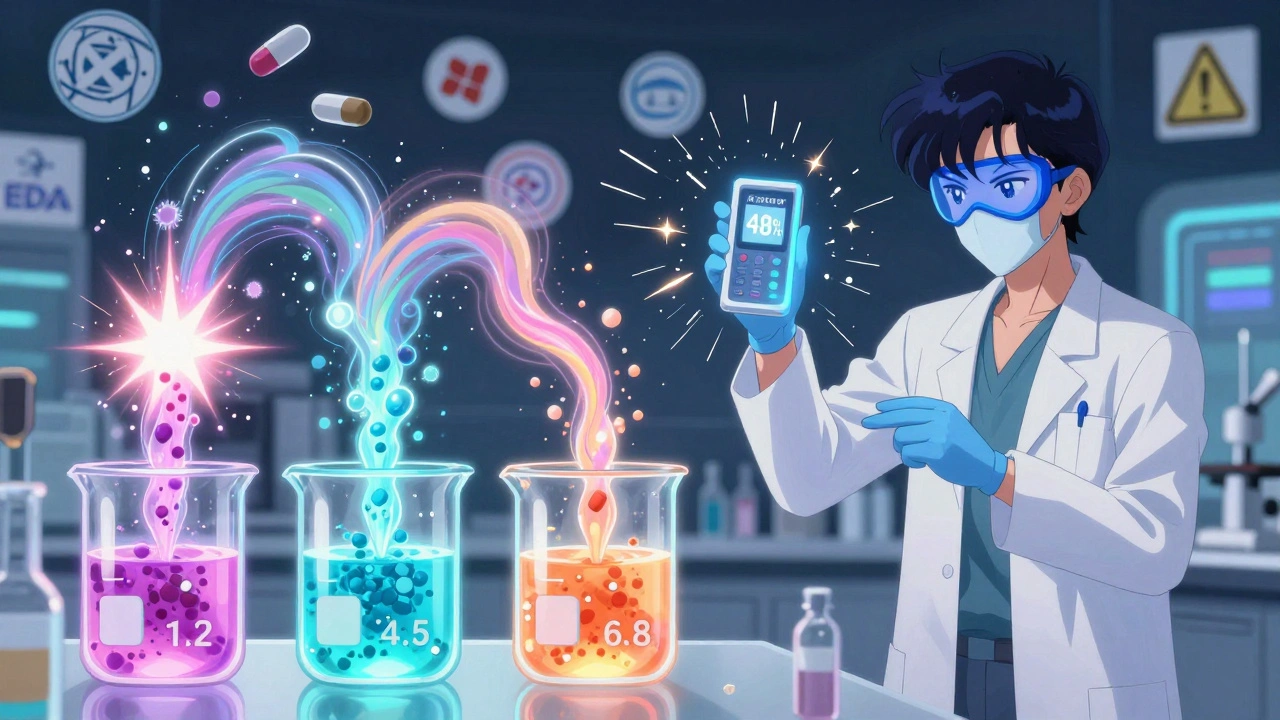
Dissolution testing is the lab’s first line of defense. For MR tablets, the FDA demands testing at three pH levels: 1.2 (stomach), 4.5 (upper intestine), and 6.8 (lower intestine). Why? Because a drug’s release can change dramatically depending on where it is in the gut. A formulation that works in pH 6.8 might collapse in stomach acid, causing a sudden dump of drug - known as “dose dumping.”And it’s not just about matching the brand’s curve. The FDA requires a similarity factor (f2) of at least 50 between test and reference products. In practice, that means the dissolution profiles must be nearly identical across all time points. One study from a Teva scientist showed 35-40% of early oxycodone ER formulations failed this test because their release profiles didn’t align at pH 4.5.
For beaded capsules - like those used in some ADHD meds - the rules are looser. Only one pH condition is needed. But that’s because the beads are designed to behave consistently regardless of gut environment. It’s a reminder: formulation design drives regulatory requirements.
Alcohol and the Hidden Danger of Dose Dumping
Here’s a real-world risk most people don’t think about: alcohol. If you take an extended-release opioid like oxycodone ER and drink even one glass of wine, the alcohol can disrupt the polymer coating that controls drug release. The result? The entire dose floods into your system at once - potentially fatal.The FDA now requires alcohol interaction studies for any ER product containing 250 mg or more of active ingredient. Since 2005, seven such products have been pulled from the market because of this exact issue. One case involved a generic version of a pain patch that released 80% of its drug within two hours when mixed with 40% ethanol - a level easily reached with moderate drinking. This isn’t theoretical. It’s life-or-death.
Highly Variable Drugs and RSABE: The Statistical Trap
Some drugs - like warfarin or clopidogrel - have wild swings in how people absorb them. Their within-subject coefficient of variation can exceed 30%. For these, standard 80-125% bioequivalence limits don’t work. Too wide, and you risk unsafe generics. Too narrow, and no generic can ever pass.This is where Reference-Scaled Average Bioequivalence (RSABE) comes in. It lets regulators widen the acceptance range based on how variable the reference drug is - but only up to a cap of 57.38%. It sounds technical, but it’s critical. A Mylan clinical pharmacologist reported that implementing RSABE for a highly variable MR drug added 6-8 months to development time. Why? Because you need more participants, longer sampling periods, and advanced statistical modeling. One failed application cost over $2 million in retesting.
Why Some Generics Still Fail - Even When They Pass the Tests
Here’s the uncomfortable truth: some generic MR drugs meet all regulatory criteria and still cause problems. A 2016 study in Neurology found that 18% of generic extended-release antiepileptic drugs had seizure breakthrough rates 1.3 to 2.1 times higher than the brand - even though they passed bioequivalence tests.Why? Because bioequivalence measures exposure, not effect. Two drugs might deliver the same amount of drug over time, but if one releases it slightly faster in the brain or interacts differently with transporters, the clinical outcome can differ. This is especially true for drugs with narrow therapeutic indices - where the difference between a therapeutic dose and a toxic one is tiny.
That’s why the FDA requires tighter limits (90-111.11%) for NTI drugs like warfarin. Even a 5% shift can matter. And yet, many generic manufacturers still treat MR products like regular pills. The result? A quiet crisis of therapeutic inequivalence that regulators are only beginning to address.

Cost, Complexity, and the Real Barrier to Entry
Developing a generic MR drug isn’t just harder - it’s exponentially more expensive. While a standard immediate-release generic might cost $2-3 million to develop, an MR version can run $7-10 million. Why? Because you need specialized dissolution equipment (USP Apparatus 3 or 4 instead of the standard 2), advanced pharmacokinetic modeling software (like Phoenix WinNonlin), and teams trained in RSABE statistics.And the learning curve? Rough. A 2022 ISoP survey found that pharmacokinetic scientists need 12-18 months of dedicated training just to handle MR bioequivalence studies. Most small biotechs can’t afford it. That’s why 97% of MR generic applications come from just five big CROs: PRA Health Sciences, Covance, ICON, Syneos, and PPD.
Still, there are wins. Sandoz saved $1.5 million and 10 months on an ER tacrolimus generic by using a biowaiver - proving dissolution similarity (f2=68) without running a full clinical study. That’s the future: smarter, science-driven shortcuts. But only if you understand the science deeply enough to use them.
The Future: IVIVC, PBPK, and Smarter Testing
The next big shift is moving away from brute-force clinical trials. The FDA has accepted 12 Level A In Vitro-In Vivo Correlation (IVIVC) models since 2019 - where lab dissolution data can reliably predict how the drug behaves in the body. If you can prove this link, you might skip human studies entirely.Meanwhile, physiologically based pharmacokinetic (PBPK) modeling is gaining traction. Sixty-eight percent of big pharma companies now use it to simulate how a drug will behave across different populations, gut pH levels, or food conditions. It’s not perfect - but it’s getting closer. The FDA plans to release a new guidance in 2024 specifically for complex MR systems like gastroretentive and multiparticulate formulations. That’s a signal: regulators know the old rules aren’t enough.
By 2028, IQVIA predicts modified-release drugs will make up 42% of all prescription sales. Aging populations, chronic diseases, and the push for once-daily dosing are driving demand. But if we don’t fix how we test them, we risk flooding the market with generics that look right on paper - but don’t work right in people.
Why can’t we use the same bioequivalence rules for modified-release drugs as we do for immediate-release ones?
Immediate-release drugs release all their drug quickly, so measuring total exposure (AUC) and peak level (Cmax) tells you everything. Modified-release drugs are designed to release drug over hours or in stages. Two products can have the same AUC and Cmax but release the drug at completely different times - leading to underdosing at night or overdose in the morning. That’s why regulators require additional metrics like partial AUC, dissolution profiles, and sometimes steady-state studies.
What is dose dumping, and why is it dangerous?
Dose dumping happens when an extended-release drug releases its entire dose too quickly - often because of something like alcohol, food, or stomach pH changes. For opioids or other potent drugs, this can cause a sudden, toxic spike in blood levels. Between 2005 and 2015, seven ER products were pulled from the market due to alcohol-induced dose dumping. That’s why the FDA now requires alcohol interaction testing for any ER product with 250 mg or more of active ingredient.
What’s the difference between FDA and EMA requirements for MR bioequivalence?
The FDA mostly uses single-dose fasting studies and focuses on partial AUC for multiphasic drugs. The EMA often requires steady-state studies, especially if the drug builds up in the body. The EMA also uses different metrics like half-value duration (HVD) and midpoint duration time (MDT), while the FDA sticks to pAUC. Dissolution testing rules also differ: FDA requires three pH levels for tablets; EMA allows fewer under certain conditions. These differences mean a generic approved in the U.S. might not be approved in Europe - and vice versa.
Why do some generic MR drugs cause seizures even when they pass bioequivalence tests?
Bioequivalence tests measure how much drug enters the bloodstream, not how it affects the brain or interacts with receptors. Two drugs might have identical AUC and Cmax, but if one releases drug slightly faster in the central nervous system, or binds differently to proteins, it can trigger seizures in epileptic patients. This is especially risky with narrow therapeutic index drugs. A 2016 study found 18% of generic extended-release antiepileptics had higher breakthrough seizure rates despite passing standard tests.
Can a generic modified-release drug get approved without a human clinical study?
Yes - but only in rare cases. If a manufacturer can prove a perfect In Vitro-In Vivo Correlation (IVIVC), where lab dissolution data reliably predicts how the drug behaves in the body, regulators may allow a biowaiver. This has been approved for 12 products since 2019, including paliperidone ER. It requires extremely detailed dissolution testing, modeling, and validation. Most MR generics still need full clinical bioequivalence studies.
What You Need to Do Next
If you’re developing a generic MR product, start by studying the FDA’s 2022 guidance and the product-specific guidance for your drug. Don’t assume what worked for an immediate-release version will work here. Test dissolution at all required pH levels. Run alcohol interaction studies if your drug is over 250 mg. Plan for partial AUC if it’s biphasic. And if your drug is highly variable, get your RSABE model ready early - it’s not optional.If you’re a prescriber or pharmacist, don’t assume all generics are interchangeable - especially for MR drugs. Check if the generic has the same release mechanism as the brand. If a patient reports unexpected side effects or loss of efficacy after switching, consider bioequivalence gaps as a possible cause - not just non-adherence.
Modified-release formulations are the future of chronic disease management. But they’re also the most dangerous area for generic substitution - if we don’t test them right. The science is complex. The stakes are high. And the rules are changing fast. Stay informed - because patient safety depends on it.
Laura Saye
December 4, 2025 AT 13:18It’s wild how we treat these complex drug delivery systems like they’re just slower pills. The science behind multiparticulate systems and osmotic pumps is so elegant-almost like micro-engineered time capsules. But we’re still using 1980s bioequivalence logic to approve them. It’s not just regulatory inertia; it’s a systemic blind spot. Patients aren’t lab rats. Their bodies aren’t uniform. And yet we act like matching AUC and Cmax is the whole story.
I’ve seen patients on generic ER gabapentin go from stable to having breakthrough pain within weeks. No one blames the drug-they blame the patient for ‘not adhering.’ But what if the drug just didn’t release where it needed to? That’s the silent crisis.
Michael Dioso
December 6, 2025 AT 11:22LMAO so the FDA is now basically saying ‘if it looks the same on paper, it’s fine’? You know what’s really dangerous? Letting some Chinese generic lab in Guangdong replicate a polymer coating with a 3D printer and a bottle of glue. They don’t care about f2 scores or pH 4.5 dissolution-they care about profit margins. And now we’re supposed to trust that a pill made in a basement with a $200 tablet press is equivalent to a $1000 branded one? Wake up.
And don’t get me started on RSABE. That’s just statisticians inventing math to make bad drugs look good. It’s corporate fraud dressed up as science.
Krishan Patel
December 8, 2025 AT 06:55Let me be clear: this entire system is a betrayal of public trust. The FDA’s reliance on single-dose studies is not just negligent-it is morally indefensible. How many patients have suffered because regulators chose convenience over clinical truth? The EMA may be rigid, but at least they demand proof of stability under real-world conditions. You cannot reduce human physiology to a single fasting blood draw.
And dissolution testing at three pH levels? That’s the bare minimum. What about gut microbiota variation? Gastric emptying time? Genetic polymorphisms in drug transporters? These are not footnotes-they are the core of pharmacology. Yet we pretend that matching a curve on a graph is equivalent to therapeutic equivalence.
When the system prioritizes speed over safety, it is not innovation-it is exploitation. And the beneficiaries are not patients. They are shareholders.
sean whitfield
December 8, 2025 AT 07:02so like... the government says its safe but we all know its not
they just want you to take the cheap pill so they can save money
and if you die its not their fault
lol
Carole Nkosi
December 9, 2025 AT 07:56Every time I see a comment that says ‘it’s just math’ I want to scream. This isn’t math. This is life or death. You think a seizure is a statistical outlier? No. It’s a mother who can’t pick up her kid because the generic didn’t release properly. You don’t fix this with better models. You fix it by demanding real-world data. Not lab simulations. Not f2 scores. Real patients. Real outcomes.
And if the big pharma companies don’t want to pay for it? Then stop letting them control the regulatory narrative. They’ve had too much power for too long.
Stephanie Bodde
December 9, 2025 AT 19:24This is such an important topic and I’m so glad someone’s talking about it! 💙
As a pharmacist, I’ve had patients come in crying because their seizure meds ‘stopped working’ after switching generics. No one listens. We’re told ‘it’s bioequivalent’ and that’s it. But if they’re having breakthrough seizures, it’s not working.
Please, prescribers-when you switch someone to a generic MR drug, ask them how they feel after 2 weeks. Don’t assume. Don’t dismiss. Listen. And if something feels off? Switch back. Your patient’s life matters more than the cost savings.
And to the regulators: PLEASE update the guidelines. We’re not asking for perfection-just honesty.
Philip Kristy Wijaya
December 10, 2025 AT 14:37One must consider the broader economic architecture underpinning pharmaceutical innovation and access. The current regulatory paradigm incentivizes commodification over clinical fidelity. While the FDA’s expedited pathways reduce development timelines and lower barriers to market entry, they simultaneously erode the evidentiary threshold for therapeutic equivalence. This is not merely a scientific deficiency-it is a structural failure of governance
It is imperative that we recalibrate our metrics to prioritize pharmacodynamic fidelity over pharmacokinetic proxy measures. The notion that AUC and Cmax are sufficient for modified-release systems is an epistemological fallacy rooted in reductionist thinking
Moreover, the monopolistic consolidation among CROs creates an oligopolistic bottleneck that stifles innovation and perpetuates systemic bias in trial design. This is not science. This is cartelization dressed in white coats
Jennifer Patrician
December 11, 2025 AT 11:53They’re lying. All of it. The FDA, the EMA, the CROs, the ‘experts’-they’re all in on it. You think alcohol interaction studies are for patient safety? No. They’re for cover. The real reason they pull drugs is when someone dies and the lawsuit gets too loud.
And RSABE? That’s just a fancy word for ‘we let the generics slide because we’re too lazy to do real testing.’
And don’t even get me started on IVIVC. That’s the new snake oil. They’ll say ‘oh this model predicts bioavailability’-but it’s all based on data from 12 healthy young men in a lab. What about an 80-year-old diabetic with kidney disease? You think it works the same? No. It doesn’t. And they know it.
This isn’t science. It’s corporate theater. And we’re the audience.
Mellissa Landrum
December 13, 2025 AT 11:14so like... if you're american and you take a generic and you die its your fault for not buying the brand right
but if you're in india or africa and you take a generic and you die its just 'global health access'
double standard much?
also why is everyone so mad at the FDA but not at the chinese factories that make the pills
they dont even test the ingredients
its all about the money