
When a generic drug hits the market, it’s not the end of the story-it’s just the beginning of a long, regulated journey. The FDA doesn’t just approve a drug once and walk away. If the manufacturer changes anything about how it’s made-whether it’s the equipment, the process, the supplier, or even the factory floor-the FDA needs to decide: does this change still keep the drug safe, effective, and identical to the brand-name version? That’s where manufacturing changes and re-evaluation come in.
Why Does the FDA Care About Manufacturing Changes?
Generic drugs aren’t copies. They’re legally required to be bioequivalent to the brand-name drug-the same active ingredient, same strength, same way it’s taken, and same effect in the body. But here’s the catch: two pills can have identical ingredients and still behave differently if they’re made differently. A change in how the powder is mixed, the temperature during drying, or even the type of machine used to press tablets can affect how quickly the drug dissolves in your body. That’s why the FDA requires manufacturers to prove, every single time they change something, that the drug still works the same way.The system is built on the Abbreviated New Drug Application (ANDA), which lets generic companies skip repeating the expensive clinical trials the brand-name maker did. Instead, they focus on proving their version matches the original in quality and performance. But if the manufacturing process changes, that proof has to be redone. The FDA doesn’t want patients to get a drug that’s slightly less effective-or worse, unsafe-because of a factory upgrade.
What Kind of Changes Trigger a Full Re-Evaluation?
Not every tweak needs a full FDA review. The agency classifies changes into three buckets based on risk:- Prior Approval Supplements (PAS) - High-risk changes that require FDA approval before you can even make the switch. These include switching to a new active ingredient supplier, changing the synthesis route of the drug, moving production to a new factory, or increasing batch size by more than 50%. A 2022 case showed a company trying to scale up a tablet production line had to submit 6 months of stability data and waited 14 months for approval.
- Changes Being Effected (CBE) - Medium-risk changes you can make right away, but you must notify the FDA within 30 days. Examples include updating packaging materials, changing the color of a pill, or adjusting in-process testing methods. You can implement these changes immediately, but the FDA can still ask you to pull the product if they find issues.
- Annual Reports (AR) - Low-risk changes that you just report once a year. Think minor equipment calibration, updating a label, or changing the lot number format.
According to FDA data from 2018-2022, PAS submissions jumped 27.3% over five years. Why? Not just because companies are making reckless changes. More often, it’s because they’re trying to improve. A 48.7% of PAS filings were for upgrades-like switching to continuous manufacturing, using better sensors, or automating processes. But even good changes can trigger a full review if they’re not well documented.
What Makes a Change High-Risk?
The FDA looks at three things when deciding if a change needs PAS approval:- Impact on drug release - Does the change affect how fast the drug dissolves? For example, changing the binder in a tablet can slow down absorption. If the drug’s release profile shifts outside the FDA’s acceptable range, it’s a PAS.
- Impurity profile - New manufacturing methods can create new byproducts. For complex generics like peptides, any new impurity must be under 0.5% and proven not to affect safety. One manufacturer had to scrap a new purification step because it created a trace impurity that hadn’t been in the original drug.
- Process variability - If the new process is less consistent, the FDA will want more data. A change that makes the drug less predictable from batch to batch is a red flag.
Even small changes can become big problems. A 2023 survey found that 28.7% of PAS rejections came from analytical method changes-like switching from one HPLC machine to another. Why? Because if the test doesn’t measure the same thing the same way, the FDA can’t trust the results. It’s not about the drug-it’s about whether you can prove it’s unchanged.

How Long Does Re-Evaluation Take?
The timeline isn’t the same for everyone. The FDA’s average review times are:- PAS: 10 months (but complex cases can stretch to 18+ months)
- CBE-30: 3 months
- CBE-0: 9 months
But here’s the kicker: 68.4% of PAS submissions get a complete response letter-meaning the FDA says, “We need more data.” The most common reasons? Facility transfers (24.5%), analytical method changes (28.7%), and formulation tweaks (19.3%).
Some companies get stuck in a loop. One manufacturer in a Reddit thread described a tablet press upgrade that took 18 months to approve-even though the final product met all specs. Why? The FDA wanted proof the new machine didn’t alter the tablet’s hardness distribution. That’s not about safety-it’s about consistency. And consistency is everything.
Who Gets Hit Hardest?
Small manufacturers suffer the most. A 2023 survey of 127 generic companies showed that those with fewer than 5 ANDAs had 43% longer review times than big players. Why? They lack the teams to prep complex submissions. A PAS isn’t just paperwork-it needs data from quality control, analytical labs, manufacturing, and regulatory affairs. Small companies often don’t have all those people in-house.Big companies like Teva and Sandoz have learned to play the system. Teva’s 2022 approval for continuous manufacturing of amlodipine took only 8 months-half the average-because they held 5 pre-submission meetings with the FDA and shared every bit of data upfront. They didn’t guess what the FDA wanted. They showed it.
How Can Manufacturers Avoid Delays?
The best way to avoid a PAS nightmare is to design for change from day one. The FDA’s 2021 guidance pushed Quality by Design (QbD)-a method where manufacturers map out the entire manufacturing process, identify what variables matter most, and define a “design space” where changes won’t hurt quality.Companies using QbD and Process Analytical Technology (PAT)-real-time sensors that monitor production-reported 32.6% fewer PAS submissions over five years. Why? Because they already knew how their process behaved. If a change stays within the pre-approved design space, they don’t need to ask for permission-they just report it.
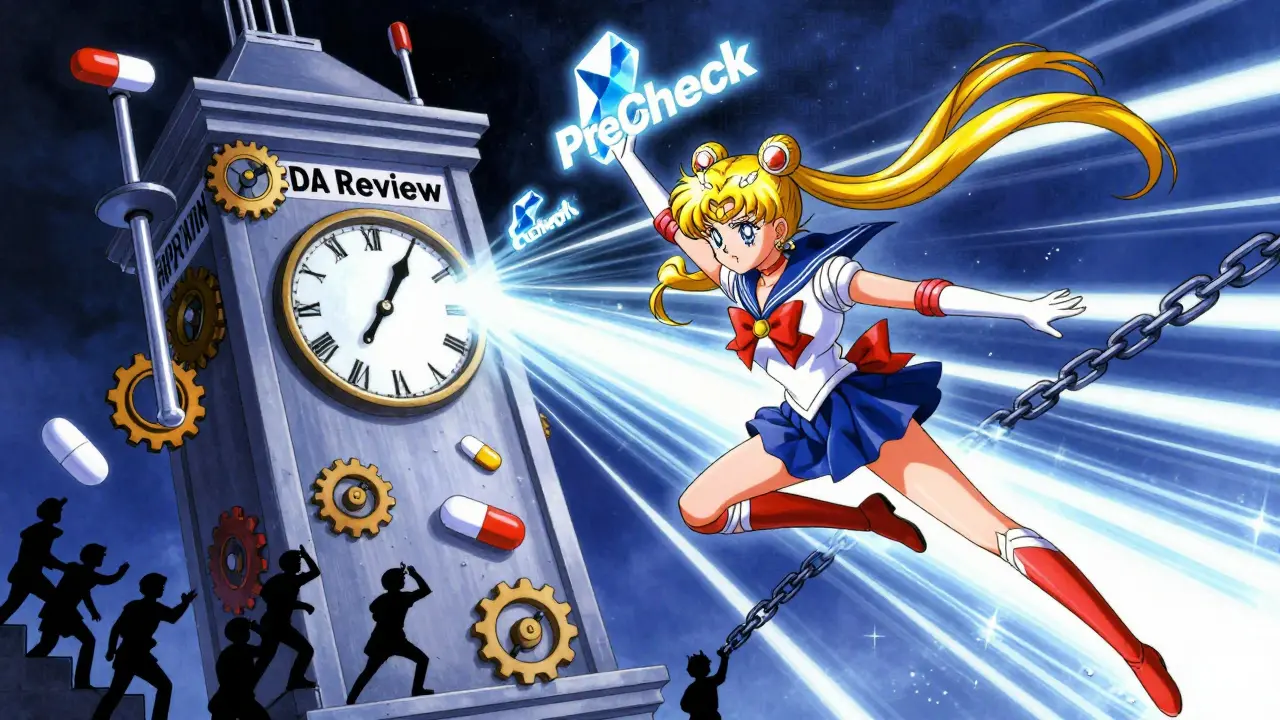
Another trick? Use the FDA’s PreCheck program, launched in February 2024. It lets manufacturers get early feedback on facility upgrades before they invest millions. If you’re planning to move production to a new plant, submit your plans early. Get the FDA’s input before you buy the equipment. That alone can cut approval time from 18 months to 9.
The Bigger Picture: Why This Matters
The U.S. generic drug market was worth $113.7 billion in 2023. But manufacturers are caught between two forces: price pressure and regulatory cost. A single PAS can cost $287,500 to prepare. For a low-margin drug selling for pennies, that’s not worth it. So many companies avoid improvements-even ones that would make drugs safer or more reliable.That’s changing. In September 2023, the FDA launched the ANDA Prioritization Pilot Program. If your drug is made in the U.S., uses U.S.-sourced active ingredients, and has U.S.-based bioequivalence data, you can get reviewed in 8 months instead of 30. The goal? Encourage $4.2 billion in new U.S. manufacturing by 2027.
And in January 2024, the FDA released draft guidance proposing a new tiered system for complex generics. It could reduce PAS submissions by up to 35% for minor changes. That’s huge. It means more companies might finally invest in better tech-like automation, AI-driven quality control, or real-time release testing-without fearing a 2-year delay.
What’s Next?
The next big shift comes with GDUFA IV, the next round of user fee negotiations scheduled for 2025. Industry groups are pushing for standardized rules across FDA review divisions. Right now, two different reviewers might classify the same change differently-leading to 41.7% variation in how companies submit. Standardization could cut confusion, delays, and wasted money.For manufacturers, the message is clear: don’t wait until you’re forced to change. Build flexibility into your process now. Use QbD. Talk to the FDA early. Document everything. The cost of not acting isn’t just delayed approval-it’s losing market share to competitors who are already ahead.
For patients, it means more reliable drugs, fewer shortages, and better access to affordable medicine. The system isn’t perfect-but it’s getting smarter. And that’s good for everyone.
What manufacturing changes require FDA approval before implementation?
Changes classified as Prior Approval Supplements (PAS) require FDA approval before you can make them. These include switching to a new active pharmaceutical ingredient (API) supplier, changing the synthesis route of the drug, moving production to a new facility, increasing batch size by more than 50%, or altering the formulation in a way that affects drug release. Any change that could impact safety, effectiveness, or quality must be submitted and approved first.
How long does the FDA take to review a manufacturing change submission?
Review times vary by submission type. Prior Approval Supplements (PAS) take an average of 10 months, but complex cases can extend to 18 months or more. CBE-30 submissions are reviewed in about 3 months, while CBE-0 submissions take around 9 months. Under the new ANDA Prioritization Pilot Program, qualifying U.S.-based manufacturers can receive approval in as little as 8 months.
Why do some generic drug manufacturers avoid making manufacturing improvements?
The cost and time of submitting a Prior Approval Supplement (PAS) can exceed $287,500 and take over a year. For low-margin generic drugs, that investment often doesn’t pay off financially. Many manufacturers fear delays, unexpected FDA requests, or facility inspections that halt production. As a result, even beneficial upgrades-like automation or better quality controls-are delayed or skipped entirely.
What is Quality by Design (QbD), and how does it help with FDA approvals?
Quality by Design (QbD) is a systematic approach where manufacturers identify critical process parameters during drug development and define a "design space"-the range of conditions where the product still meets quality standards. If a manufacturing change stays within this space, it doesn’t require a full FDA review. Companies using QbD report 40% fewer post-approval changes and faster approvals because they’ve already proven how their process behaves under variation.
Can the FDA reject a manufacturing change even if the final product meets all specs?
Yes. The FDA doesn’t just look at the final product-it looks at how you got there. If the new process introduces uncontrolled variability, changes the impurity profile, or lacks sufficient process validation, the FDA can reject the submission even if the final tablets pass all tests. For example, switching tablet presses might produce identical hardness and dissolution, but if the machine’s compression force isn’t consistently monitored, the FDA may demand more data to prove consistency across batches.
What is the ANDA Prioritization Pilot Program?
Launched in September 2023, this FDA program fast-tracks reviews for generic drugs made in the U.S. with U.S.-sourced active ingredients and U.S.-based bioequivalence testing. Instead of the standard 30-month review, qualifying applications can be approved in 8 months. The goal is to incentivize domestic manufacturing and reduce supply chain risks, with an estimated $4.2 billion in new U.S. investments expected by 2027.
How do facility transfers affect FDA approval timelines?
Transferring manufacturing to a new facility is one of the most complex changes and typically triggers a PAS. Historically, these reviews took 18 months or longer. But with the FDA’s new PreCheck program (launched February 2024), companies can submit facility plans early and receive feedback before investing. This can cut approval time in half-to about 9 months-by aligning expectations before construction begins.
Ambrose Curtis
January 28, 2026 AT 12:06James Dwyer
January 29, 2026 AT 13:42jonathan soba
January 30, 2026 AT 13:59Irebami Soyinka
January 31, 2026 AT 02:02doug b
February 1, 2026 AT 21:31Mel MJPS
February 2, 2026 AT 22:51Kevin Kennett
February 3, 2026 AT 06:24Jess Bevis
February 4, 2026 AT 18:46Rose Palmer
February 5, 2026 AT 14:05Howard Esakov
February 6, 2026 AT 12:05Rhiannon Bosse
February 6, 2026 AT 22:47Colin Pierce
February 8, 2026 AT 18:52Linda O'neil
February 10, 2026 AT 02:37