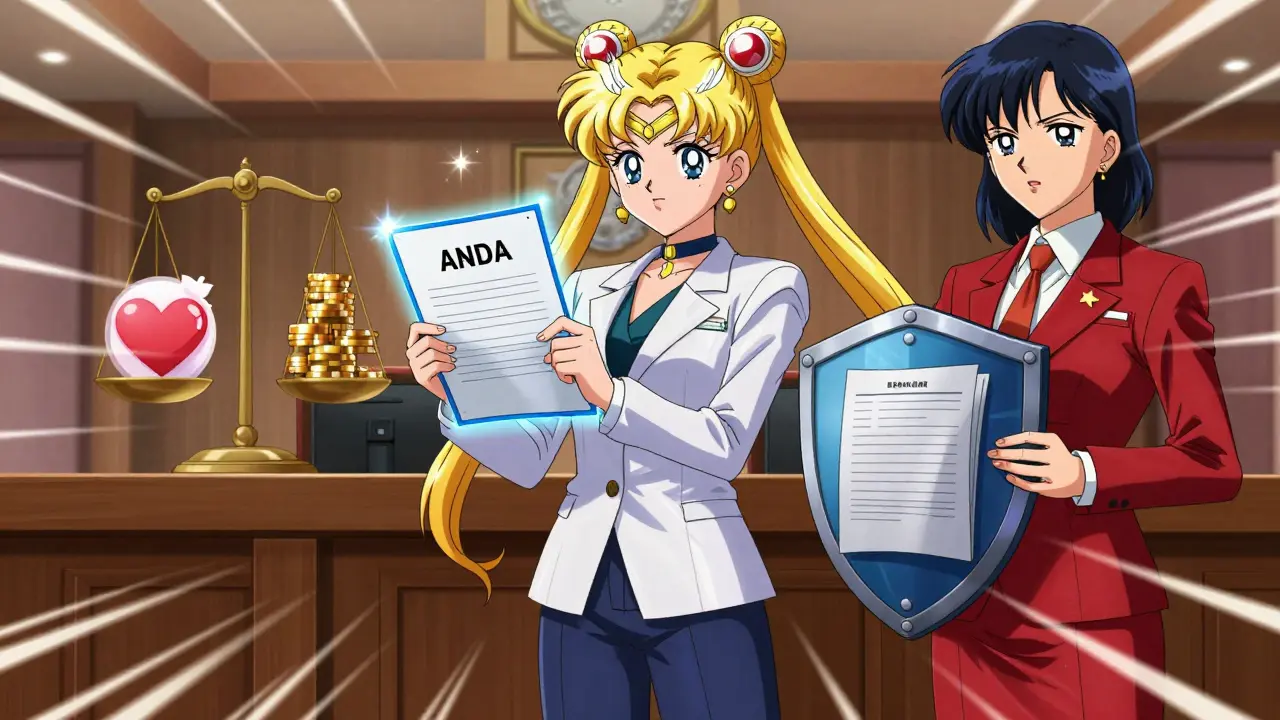
The High-Stakes Game of Generic Drug Entry
When a blockbuster drug loses its patent protection, you might expect generic versions to flood the market immediately. In reality, that rarely happens. Instead, what follows is often a complex legal battle known as pharmaceutical patent litigation, which involves legal disputes between brand-name manufacturers and generic competitors over intellectual property rights. These disputes are not just about corporate profits; they directly impact patient access to affordable medicines and drive billions of dollars in healthcare spending.
The framework governing these battles was established by the Hatch-Waxman Act, formally known as the Drug Price Competition and Patent Term Restoration Act of 1984. This legislation created a balanced system allowing generic drugs to enter the market faster while preserving incentives for innovation through patent term extensions. While designed to promote competition, the system has evolved into a strategic arena where brand companies use litigation tactics to delay generic entry, sometimes for years beyond the original patent expiration.
How the Legal Mechanism Works
To understand why generic entry is so delayed, we need to look at the specific steps involved. When a generic manufacturer wants to produce a copy of a branded drug, they file an Abbreviated New Drug Application (ANDA) with the regulatory submission required by the FDA for generic drugs that demonstrates bioequivalence to an approved brand-name product without repeating full clinical trials.
Here is where it gets tricky. The ANDA must include a certification regarding the patents listed in the Orange Book, officially titled Approved Drug Products with Therapeutic Equivalence Evaluations. This database catalogs all FDA-approved drug products along with their associated patent information and therapeutic equivalence ratings.
- Paragraph I: No patents are listed.
- Paragraph II: Patents have expired.
- Paragraph III: Patents are still valid, but the generic waits until they expire.
- Paragraph IV: The generic challenges the validity or applicability of the listed patents.
When a generic company files a Paragraph IV certification, it triggers a critical mechanism. The brand-name manufacturer has 45 days to sue for patent infringement. If they do, the FDA is legally barred from approving the generic application for 30 months. This "stay period" gives the courts time to resolve the dispute, but it also provides significant breathing room for the brand company to maintain its monopoly.
The Rise of Serial Litigation and Patent Thickets
Brand companies have become increasingly sophisticated in using this system to their advantage. A major tactic is creating what experts call "patent thickets." According to research by Dr. Rachel Sachs at Washington University, brand companies now obtain an average of 140 patents per drug. For oncology drugs, this number jumps to 237 patents.
This isn't just about protecting the active ingredient. Companies list patents for everything related to the drug, including manufacturing methods, formulation details, and even ancillary components like delivery devices or packaging. The Association for Accessible Medicines (AAM) identified ten case studies in 2025 where brands used serial litigation-filing multiple successive lawsuits using later-issued or held-back patents-to block generic competition for 7 to 10 years after the initial patent expired.
| Drug Name | Number of Patents | Primary Use |
|---|---|---|
| Eliquis (apixaban) | 67 | Blood thinner |
| Semaglutide products (Ozempic, Wegovy) | 152 | Diabetes and weight loss |
| Average Oncology Drug | 237 | Cancer treatment |
The financial impact of these delays is staggering. The Federal Trade Commission (FTC) estimated in 2024 that improper patent listings delay generic competition for approximately 1,000 drugs annually, costing the healthcare system $13.9 billion per year in excess spending.
Settlements: Pay-for-Delay or Patient Access?
One of the most controversial aspects of this landscape is settlement agreements. Critics argue that many settlements involve "pay-for-delay," where brand companies pay generics to stay out of the market, violating antitrust laws. However, recent data suggests a more nuanced picture.
A June 2025 report by the IQVIA Institute, commissioned by AAM, found that patent settlements actually accelerated generic market entry by more than five years before patent expiration on average. Industry analyst John T. O'Donnell noted that limiting a generic manufacturer's ability to settle cases doesn't reduce settlements-it reduces the number of Paragraph IV ANDAs submitted entirely. In other words, if generics can't settle, they simply won't challenge the patents in the first place.
This divergence in perspective highlights the complexity of the issue. While the FTC has challenged over 300 improper Orange Book listings in 2024, arguing that these practices harm competition, others see settlements as a pragmatic way to bring cheaper alternatives to patients sooner rather than engaging in protracted court battles.

Venue Shopping and Legal Trends
Where you file your lawsuit matters significantly in patent litigation. The Eastern District of Texas has recently reclaimed its position as the most active venue for patent cases, handling 38% of all filings in 2024. This compares to 22% in the Western District of Texas and 15% in the District of Delaware.
The surge in litigation is part of a broader trend. According to the Lex Machina 2025 Patent Litigation Report, patent litigation in the United States surged 22% in 2024, with record-breaking $4.3 billion in damages awarded. Specialized law firms like Fish & Richardson, Quinn Emanuel, and Jones Day reported 35-40% year-over-year increases in patent litigation practice revenue during the same period.
However, the early pandemic period saw an unusual 21% decline in Hatch-Waxman litigation in 2020. Bloomberg Law analysis attributed this not to court delays, but to a thinning pipeline of new drug approvals, creating a temporary "perfect storm" that slowed down the volume of new generic challenges.
Regulatory Pushback and Future Outlook
Regulators are becoming increasingly aggressive in addressing these issues. In May 2025, the FTC issued warning letters targeting more than 200 patents across 17 brand-name products. The agency is focusing heavily on improper listings, such as patents covering manufacturing equipment or packaging that do not meet statutory requirements for Orange Book inclusion.
A key precedent was set in 2025 in the Teva vs. Amneal litigation over ProAir HFA. Judge Chesler ruled that six patents related to the dose counter component were improperly listed because they did not claim "the drug for which the application was approved." This decision could impact 15-20% of currently listed Orange Book patents, according to Skadden's analysis.
Looking ahead, the FDA has proposed new regulations requiring brand companies to certify under penalty of perjury that each patent listed meets statutory requirements, with implementation expected in Q2 2026. Meanwhile, generic manufacturers are increasingly utilizing inter partes review (IPR) proceedings at the Patent Trial and Appeal Board (PTAB). IPR filings against pharmaceutical patents increased 47% from 2023 to 2024, although the Supreme Court's April 2025 decision in Smith & Nephew v. Arthrex limited some IPR challenges through stricter standing requirements.
The future trajectory points toward continued escalation. Lex Machina predicts 25-30% annual growth in pharmaceutical patent litigation through 2027, driven by increasingly complex biologic and biosimilar disputes. As the average number of patents per biologic product rises to 78 compared to 37 for small molecule drugs, the legal battlefield will only become more crowded and expensive.
What is the Hatch-Waxman Act?
The Hatch-Waxman Act, formally known as the Drug Price Competition and Patent Term Restoration Act of 1984, is a U.S. federal law that created a streamlined pathway for generic drug approval while providing patent term extensions to brand-name manufacturers to compensate for time lost during regulatory review. It balances the need for affordable generic competition with incentives for pharmaceutical innovation.
What does a Paragraph IV certification mean?
A Paragraph IV certification is a statement included in an Abbreviated New Drug Application (ANDA) where a generic manufacturer asserts that one or more patents listed in the Orange Book for the brand-name drug are invalid, unenforceable, or not infringed by the generic product. Filing this certification triggers a 30-month stay on FDA approval if the brand company sues for patent infringement.
Why are there so many patents for a single drug?
Brand companies create "patent thickets" by filing numerous patents covering various aspects of a drug, including formulations, manufacturing processes, delivery devices, and methods of use. This strategy aims to extend market exclusivity beyond the core compound patent expiration, making it difficult and costly for generic competitors to enter the market without facing multiple legal challenges.
Do patent settlements help or hurt patients?
This is a debated topic. Critics argue that "pay-for-delay" settlements harm patients by keeping prices high. However, recent studies suggest that settlements often accelerate generic entry by years compared to waiting for patent expiration. Limiting settlements may result in fewer generic challenges overall, potentially delaying access even further.
What is the Orange Book?
The Orange Book, officially titled Approved Drug Products with Therapeutic Equivalence Evaluations, is a publication by the FDA that lists all approved drug products along with their associated patent information and therapeutic equivalence ratings. It serves as the primary reference for generic manufacturers to determine patent status when filing ANDAs.
What is the 30-month stay?
The 30-month stay is a regulatory pause imposed by the Hatch-Waxman Act. When a brand company sues a generic applicant for patent infringement after a Paragraph IV certification, the FDA cannot approve the generic drug for 30 months. This period allows courts to resolve the patent dispute before the generic enters the market.
Which court handles the most patent cases?
The Eastern District of Texas handles the highest volume of patent litigation cases, accounting for 38% of all filings in 2024. It is followed by the Western District of Texas (22%) and the District of Delaware (15%). The Eastern District of Texas is known for its patent-friendly procedures and experienced judiciary.
What is Inter Partes Review (IPR)?
Inter Partes Review (IPR) is a proceeding conducted by the Patent Trial and Appeal Board (PTAB) within the USPTO. It allows third parties to challenge the validity of existing patents based on prior art. Generic manufacturers increasingly use IPR as an alternative or supplement to district court litigation to invalidate brand-name patents.
Lori Wildrick
May 15, 2026 AT 13:43I read through this whole thing and honestly, it makes my head spin a little bit. It is so nice to see someone break down the Hatch-Waxman Act in such a clear way because I always thought the system was just broken on purpose. The part about patent thickets really stuck with me though. I mean, 237 patents for one cancer drug? That seems like way too much protection for something that should be accessible to everyone who needs it. I hope the new regulations from the FDA actually make a difference because patients are suffering while these companies fight over profits. It gives me a small amount of hope that settlements might actually help get generics out faster than we think.
Emma Olliff
May 16, 2026 AT 17:17Oh, please. This article is dripping with naive optimism that only someone disconnected from reality could produce. You think settlements are 'pragmatic'? They are blatant extortion tactics wrapped in legal jargon to fool people like you. The idea that brand companies are acting in good faith is laughable at best and insulting at worst. They create these absurd patent thickets specifically to exploit loopholes and keep prices artificially high while you sit there wondering why your insulin costs more than your rent. Do not let the IQVIA report fool you; they are paid shills for the industry. The FTC is right to challenge them, but even their efforts are half-hearted compared to what is needed. Stop apologizing for corporate greed and start demanding actual competition instead of these sham legal battles that delay access by years. It is disgusting how easily people accept these delays as 'normal' when it is clearly designed to bleed consumers dry.
Diana Wiechecka
May 17, 2026 AT 05:57Wow, thanks for sharing this! 🌟 It is crazy how complex the pharmaceutical world is. I never knew about the Paragraph IV certification before reading this. It is kind of wild that filing a lawsuit stops the FDA for 30 months automatically. That seems like a huge loophole if you ask me. 😮 But it is interesting to hear that settlements might actually speed things up sometimes. I guess everything has its pros and cons. Thanks for the info! 👍
Kathryn Byrd
May 17, 2026 AT 06:12The data regarding the Eastern District of Texas handling 38% of filings is quite significant. It suggests a systemic preference for certain venues that may influence outcomes regardless of merit. The increase in litigation revenue for firms like Fish & Richardson indicates that the legal system itself has become a profit center rather than a mechanism for justice. One must consider whether the current framework incentivizes innovation or merely incentivizes litigation strategy. The distinction between valid patent protection and strategic delay is often blurred by these practices.
Tanya KLIMCHUK Klimchuk
May 18, 2026 AT 11:31Let me tell you, this is exactly why I hate the current system. It is rigged from top to bottom. These big pharma companies know exactly how to game the rules. They file hundreds of patents for packaging and delivery devices just to stall generic entry. It is not about protecting innovation; it is about protecting their monopoly. The Teva vs. Amneal case is a perfect example of how absurd this has gotten. Patents on dose counters? Really? That is ridiculous. We need stricter enforcement now. The FTC warning letters are a start, but we need Congress to step up and rewrite the Hatch-Waxman Act to close these loopholes once and for all. Patients cannot wait any longer for affordable drugs. This greed has to stop.
Anthony Red
May 19, 2026 AT 20:31Hey folks, great discussion here. I work in healthcare admin, and seeing these numbers is pretty eye-opening. The $13.9 billion in excess spending per year is a massive burden on our systems. I appreciate Lori bringing up the patient perspective, and Emma, while you are harsh, you are right that the incentives are skewed. Diana, those emojis are cute but the issue is serious. Kathryn, you are spot on about the venue shopping. Javier, calm down a bit, but yeah, it is frustrating. Kris, save the conspiracy theories for another day. Let us focus on the facts: the 30-month stay is a double-edged sword. It protects IP but also delays access. The key is finding a balance where innovation is rewarded but not weaponized against public health. We need more transparency in these settlement deals.
Javier Arauz
May 20, 2026 AT 18:13This is typical American corruption. Big Pharma owns the courts and the regulators. They use our own laws to strangle competition and keep prices high for Americans while selling cheap elsewhere. The Eastern District of Texas is a joke. It is a rubber stamp for these greedy corporations. We need to stop buying into their lies about 'innovation.' Most of these drugs are just repackaged versions of older ones. The government needs to take control and force price caps immediately. Until then, we are all victims of this capitalist machine.
Kris Wong
May 21, 2026 AT 10:09You guys are missing the bigger picture. 🕵️♂️ The FDA and the FTC are in on it. Think about it. Why would they crack down on patent thickets now after decades of ignoring them? It is because the narrative is shifting. The 'pay-for-delay' settlements are just a cover-up for deeper collusion between brand companies and regulatory bodies. The Teva case was fixed. Judge Chesler had no choice but to rule that way under pressure from lobbyists. The rise in IPR filings is not about justice; it is about creating more paperwork to bury the truth. The Supreme Court decision in Smith & Nephew v. Arthrex was a signal to shut down challenges. Wake up sheeple! 🐑 The generic market is an illusion designed to keep you compliant while they harvest your wealth. Follow the money. 💸