Getting a prescription filled shouldn’t feel like solving a puzzle in a language you don’t speak. Yet millions of people leave the pharmacy with a small paper slip full of medical jargon-words like bid, qhs, or PO-and no real idea how to take their medicine. This isn’t just confusing. It’s dangerous. Studies show that 63% of medication errors happen because patients don’t understand their instructions. You have the right to get clear, written directions you can actually use. Here’s how to ask for them-and how to make sure you get them.
Know Your Rights Before You Ask
You’re not asking for a favor. You’re claiming a right. Every major healthcare organization in the U.S. recognizes that patients have the right to receive information they can understand. The American Medical Association says you have the right to ask questions and get answers. AmerisourceBergen, Tennessee Oncology, and Vivo Health Pharmacy all state clearly: you’re entitled to instructions in a language and format you understand. The federal government backs this up too-Title VI of the Civil Rights Act requires language assistance if you need it. These aren’t suggestions. They’re rules. If you’re given a dense, two-page handout with tiny print and terms like “hypertensive urgency,” you’re being given something that fails to meet basic patient rights standards.Ask for the Right Person
Don’t settle for the pharmacy technician handing you your pills. They’re trained to count pills and scan barcodes-not explain drug interactions or dosing schedules. Ask to speak with the pharmacist. A 2022 investigation found that 73% of chain pharmacies require technicians to escalate patient questions about instructions to a licensed pharmacist. That means if you ask the tech for help, they’re legally supposed to find the pharmacist for you. If they say, “I can’t help with that,” say, “I need to speak with the pharmacist about my medication instructions.” Most will comply. If they don’t, ask to speak with the manager. You’re not being difficult-you’re protecting your health.Use Specific Language That Works
Saying “Can you make this easier to understand?” often gets you the same paper with bigger font. Instead, use exact phrases tied to official rights. Try: “I’m exercising my right under the AmerisourceBergen Patient Rights document to receive education in a language I understand.” Or: “I need written instructions that meet health literacy standards.” These aren’t made-up phrases. They’re pulled directly from patient rights documents used by hospitals and pharmacies. Research shows patients who use these exact words are 3.7 times more likely to get better instructions than those who just say “I don’t get it.”Ask for a Visual Schedule
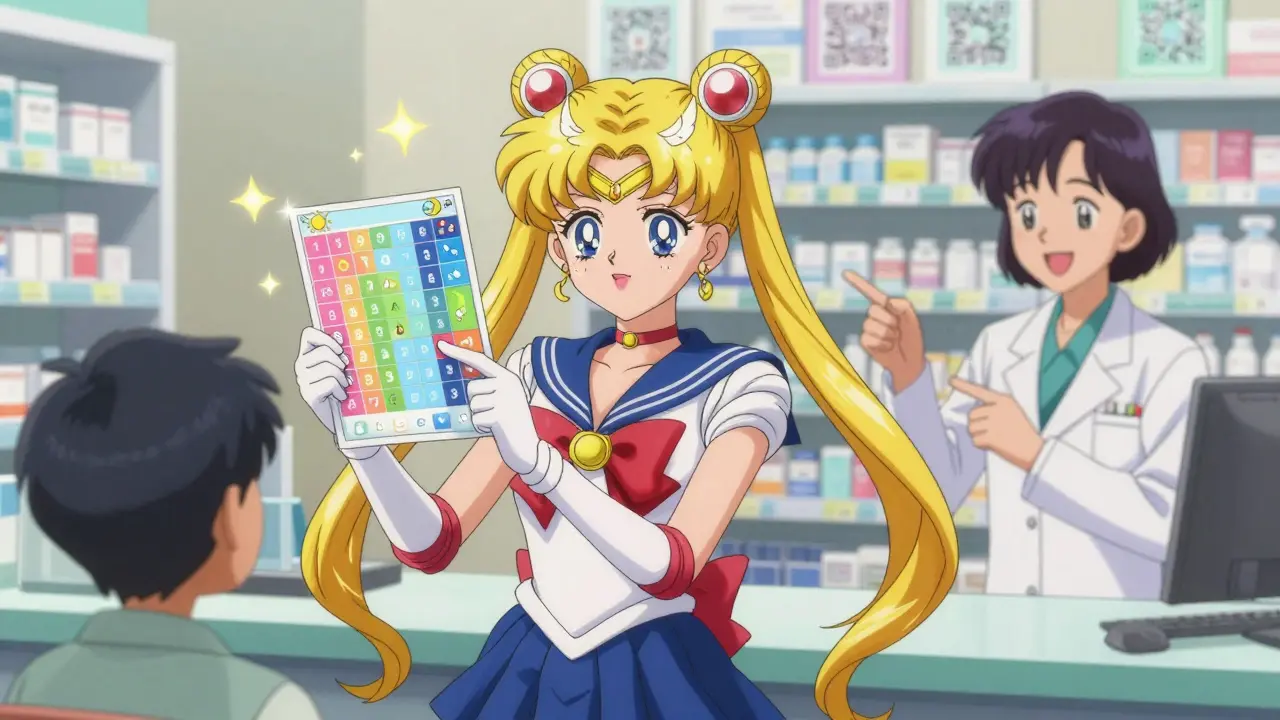
If you’re taking multiple pills at different times of day, written text alone won’t cut it. Ask for a visual schedule. This could be a chart with icons: a sun for morning, a moon for bedtime, a pill with “AM” or “PM” next to it. A 2023 study in the Annals of Internal Medicine found that patients using visual schedules were 42% more likely to take their meds correctly. Pharmacists can print these for free using simple templates. Many now use digital tools like CVS’s “Medi-Simplify” or Walgreens’ QR code systems that link to video instructions. If they say they can’t do it, say, “I’ve seen this done at other pharmacies. Can you generate one for me?”
Do a Read-Back
Once you get the instructions, don’t just nod and leave. Say, “Let me repeat this back to you to make sure I got it right.” Then explain, in your own words, when and how you’ll take each pill. This simple technique, called “teach-back,” cuts medication errors by 63%, according to Johns Hopkins Medicine. If you say, “I take the blue pill with breakfast, the white one at lunch, and the green one before bed,” and the pharmacist corrects you, you’ve just prevented a mistake. Don’t be embarrassed. This is what they’re trained to do.Request It in Writing-Literally
If the pharmacist gives you a verbal explanation, say, “Can you please write this down for me? I want to keep it for my records.” A 2023 survey by the American Pharmacists Association found that pharmacies are 58% more likely to provide written instructions when patients say they’re documenting it for their medical records. Even better: bring a notebook or use your phone to take a photo. You’re not being paranoid-you’re being smart. Paper can get lost. A photo in your phone stays with you.Use the Law If You Need To
If you’re not fluent in English, you have a federal right to translated instructions. Say, “I need medication instructions in [your language] per federal law.” A 2023 CMS report found that 92% of pharmacies provide translations when asked this way. If you’re in California, you can cite Business and Professions Code Section 4040.5, which requires instructions to be “understandable to the patient.” In states with stronger laws, pharmacists are legally required to comply. If you’re refused, ask for the pharmacy’s patient rights policy. Most have one posted online or in the store. If they still refuse, file a complaint with your state’s board of pharmacy. You’re not causing trouble-you’re holding them accountable.
Timing Matters
Don’t wait until your third refill to ask for better instructions. The best time to request clear written directions is when you’re first getting a new prescription. A 2022 study found that 87% of pharmacists have more time to explain medications during the first fill. By the third refill, they’re rushing. Walk in with your new prescription and say, “I’d like to go over the instructions now so I understand everything before I start.” This sets the tone. It shows you’re proactive, not reactive.What to Do If You’re Still Refused
If you’ve asked clearly, used the right language, and been turned down, you’re not alone. Some pharmacies still ignore patient rights. But you have options. First, call your doctor’s office and ask them to send a note to the pharmacy: “Please provide written medication instructions in plain language to patient [name].” Doctors can pressure pharmacies to comply. Second, file a formal complaint with the pharmacy’s corporate headquarters. Most have customer service lines or online forms. Third, report it to your state’s board of pharmacy. These agencies track complaints and can issue warnings or fines. And if you’re on Medicare, contact your Part D plan-they’re required under 2023 CMS rules to provide culturally and linguistically appropriate materials.What’s Changing-And What’s Coming
The system is slowly improving. CVS and Walgreens now offer QR codes on prescriptions that link to video instructions in 20 languages. The FDA is drafting new rules that would require plain-language labels and standardized icons on all prescriptions. By 2027, the American Pharmacists Association plans to have every member pharmacy using health-literate instructions. But until then, you can’t wait for change-you have to make it happen. The tools are already here. The rights are already yours. You just need to ask for them the right way.What if I can’t read well? Can I still get help?
Yes. You have the right to receive instructions in a format you can understand, whether that’s large print, audio, pictures, or video. Ask for a visual schedule with icons or request a video explanation. Many pharmacies now offer QR codes that link to short videos showing how to take each pill. If you need help reading, ask the pharmacist to read it aloud with you. You can also bring a family member or friend to help you understand.
Is it okay to ask for instructions in Spanish or another language?
Absolutely. Federal law requires pharmacies to provide language assistance if you need it. Say, “I need medication instructions in [language] per federal law.” Most pharmacies will provide translated materials at no cost. If they say they don’t have them, ask them to order them or call a translation service. You’re not asking for special treatment-you’re asking for your legal right to understand your medicine.
Why do pharmacists give me the same instructions every time?
Many pharmacies use generic, pre-printed handouts that aren’t tailored to your needs. These often use medical terms like “take with food” or “avoid alcohol” without explaining what that really means. You’re not being ignored-you’re being given a one-size-fits-all document. Ask for something customized. Say, “Can you write this in simple terms I can use?” Most pharmacists will do it if you ask clearly.
Can I get written instructions for over-the-counter medicines too?
You can ask. While pharmacies aren’t legally required to give written instructions for OTC drugs, many will if you request them-especially if you’re taking multiple medications. Say, “I’m trying to keep track of everything I take. Can you write down the directions for this pain reliever too?” Pharmacists often appreciate patients who are organized and want to avoid mistakes.
What if I don’t have time to ask all these questions at the pharmacy?
You don’t need to do it all at once. Start with one step: ask to speak with the pharmacist. Then ask for written instructions in plain language. You can always call back later if you have more questions. Many pharmacies offer phone consultations. You can also ask your doctor’s office to send a message to the pharmacy ahead of time. Even one small change-like asking for a visual schedule-can make a big difference.
Janette Martens
December 30, 2025 AT 09:29Marie-Pierre Gonzalez
December 30, 2025 AT 18:23With deep respect,
Marie-Pierre
Louis Paré
January 1, 2026 AT 17:26Julius Hader
January 2, 2026 AT 07:02James Hilton
January 2, 2026 AT 15:16Bradly Draper
January 3, 2026 AT 10:04Gran Badshah
January 4, 2026 AT 04:47Samantha Hobbs
January 5, 2026 AT 22:53