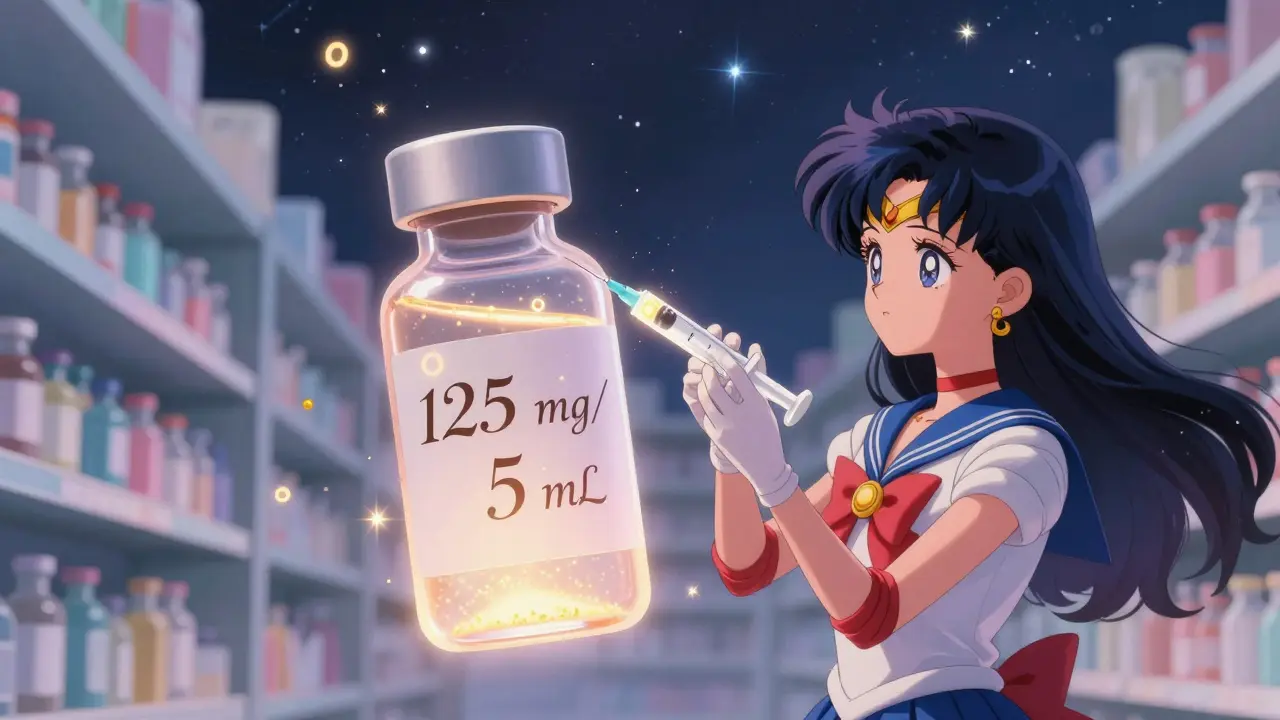
Getting the right dose of liquid medicine isn’t just about following instructions-it’s about survival. A single misread milliliter can mean the difference between healing and harm, especially for children. In the U.S., over 1.3 million injuries each year come from medication errors, and nearly half of those involve liquid prescriptions. The good news? The system has changed. The bad news? Many people still don’t know how to read the labels correctly.
What’s on the label-and what’s missing
Look at any liquid prescription bottle. You’ll see three key pieces of information: the concentration, the dosage amount, and the total volume. These aren’t just random numbers. They’re a code you need to crack to give the right amount.Concentration tells you how much medicine is in each milliliter. It’s written like this: 125 mg/5 mL. That means every 5 milliliters of liquid contains 125 milligrams of the drug. If your doctor prescribed 62.5 mg, you don’t take half the bottle-you take half of 5 mL, which is 2.5 mL. Confusing concentration with total dose is the #1 mistake people make.
Next, the dosage instruction. It might say: Take 10 mL every 6 hours. That’s clear. But if it says Take 1 teaspoon, stop. That’s outdated. By 2026, every pharmacy in the U.S. is required to use milliliters (mL) only. No more teaspoons, tablespoons, or dashes. Why? Because a kitchen teaspoon holds anywhere from 2.5 to 7.5 mL. That’s a 200% variation. One person’s “teaspoon” could be three times too much.
And don’t be fooled by the bottle size. A 118 mL bottle doesn’t mean you take 118 mL. That’s the total amount in the whole container. Your dose is still 10 mL per time. Always check the instruction line, not the bottle label.
Why mL is the only unit you should trust
The shift to milliliters didn’t happen by accident. In 2016, the FDA made it clear: liquid prescriptions must use mL. Why? Because a 2016 study in the Journal of Pediatrics found that parents using teaspoons made incorrect doses nearly 40% of the time. When they switched to mL and used proper syringes, errors dropped by over 50%.Even small decimal mistakes can be deadly. A label that says .5 mL instead of 0.5 mL can be misread as 5 mL-ten times too much. That’s why all labels now require a leading zero: 0.5 mL, never .5 mL. And never use trailing zeros: 5 mL, not 5.0 mL. That extra zero used to be common, but it caused people to think the dose was more precise than it was-and sometimes led to dangerous overmedication.
Spacing matters too. Labels must show 5 mL, not 5mL. That tiny space helps your brain separate the number from the unit. In a 2018 Johns Hopkins study, this simple change cut 10-fold dosing errors by 47%.
How to use the dosing tool that comes with your medicine
Most liquid prescriptions come with a syringe, cup, or spoon marked in mL. Never use a kitchen spoon. Even the ones labeled “teaspoon” or “tablespoon” are unreliable. A 2019 Consumer Reports test found household spoons varied by up to 200% in volume.Use the tool provided. If it’s a syringe, pull the plunger to the exact line matching your dose. Don’t guess. If it’s a cup, hold it at eye level on a flat surface. Look straight across the line-don’t look down from above. That’s how you avoid parallax error, which can throw off your dose by a full milliliter.
Some dosing tools have two sets of markings: mL and tsp. Don’t get confused. Always follow the mL line. The tsp markings are there only as a backup for older patients who still remember them. But if your label says 3.7 mL, you won’t find a 3.7 tsp line. So ignore the tsp. Trust the mL.
And here’s a pro tip: if the syringe has a cap, keep it on until you’re ready to use it. Otherwise, the medicine can dry out on the plunger and stick, making it hard to draw the full dose. Always shake the bottle well before measuring. Some medicines settle at the bottom.

What to do if the label doesn’t make sense
You’re not alone if you’re confused. A 2022 study from Nationwide Children’s Hospital found that 61% of parents had trouble understanding their child’s liquid medicine label-even when it followed all the rules. That’s why pharmacists are now required to explain the dose in person.If you’re unsure, ask. Don’t wait until you’re at home. Say: “Can you show me how much to give?” Then watch them measure it. Do it yourself in front of them. That’s called the “teach-back” method. Studies show it reduces errors by 63%.
Also, check the expiration date. Liquid medicines lose potency faster than pills. Most last 14 to 30 days after opening, even if the bottle says “expires in 2 years.” Write the opening date on the label with a marker.
And if the label says something like “240 mg/5 mL” but your prescription is for 120 mg, you don’t give half the bottle-you give half of 5 mL. That’s 2.5 mL. Always do the math: Prescribed dose ÷ Concentration per mL = Volume to give. For 120 mg of a 240 mg/5 mL solution: 120 ÷ (240 ÷ 5) = 2.5 mL.
What pharmacies are doing-and what they’re not
Big pharmacy chains like CVS, Walgreens, and Rite Aid are 92% compliant with the milliliter-only standard. But smaller, independent pharmacies? Only 58% are fully on board. Why? Older systems, cost, and lack of training.If you get a label with teaspoons, you have every right to ask for a new one. The FDA and American Pharmacists Association require pharmacists to convert all non-mL instructions to mL before dispensing. If they refuse, ask to speak to the pharmacist-in-charge. You can also request a dosing syringe if one wasn’t included.
Some pharmacies now offer QR codes on labels. Scan it with your phone, and you’ll get a short video showing exactly how to measure the dose. Amazon Pharmacy and Medly are leading this trend. It’s not everywhere yet-but it’s coming fast.
Special cases: babies, toddlers, and chronic conditions
For infants, doses are often tiny: 0.8 mL, 1.2 mL, 1.5 mL. That’s why you need a syringe with 0.1 mL markings. Never use a cup for babies. Too much spillage, too hard to control. Use a 1 mL or 3 mL syringe. Keep it clean. Rinse with water after each use.For kids with chronic illnesses-like epilepsy or cystic fibrosis-dosing is even more precise. Some medicines require doses down to 0.01 mL. That’s when you need a special syringe from the pharmacy, not the one that came with the bottle. Always ask.
And if your child is on multiple liquid medicines, keep them in separate containers. Don’t mix them. Even if they’re the same color, the doses are different. Use colored tape or labels to tell them apart.
What’s next? The future of liquid medicine labels
By 2025, the FDA plans to require pictograms on all liquid labels-simple images showing how to draw up the dose. Think: a syringe with a line at 5 mL. Early tests show this cuts errors by 37%.Also, the American Academy of Pediatrics is rolling out a new program in 2024: every well-child visit will include a quick lesson on reading liquid medicine labels. That’s because 41% of parents get zero guidance when they pick up the prescription.
And soon, smart packaging will be common. Bottles with Bluetooth sensors that remind you when to give the next dose-and alert you if you’ve given too much. These aren’t sci-fi. They’re already in pilot programs in Boston and Chicago.
But here’s the truth: no technology replaces understanding. The best tool is still your eyes, your brain, and asking one simple question: “Can you show me?”
What should I do if the label says ‘teaspoon’ instead of ‘mL’?
Ask the pharmacist to rewrite the label using milliliters. By law, they are required to convert all non-metric units to mL before dispensing. If they refuse, request to speak to the pharmacist-in-charge. You can also ask for a new bottle with the correct labeling. Never use a kitchen spoon to measure liquid medicine.
Why is 0.5 mL written with a zero before the decimal?
Writing ‘0.5 mL’ instead of ‘.5 mL’ prevents dangerous mistakes. A decimal point without a leading zero can be missed or misread as ‘5 mL’-ten times the intended dose. This simple rule, required by the FDA and NCPDP, has reduced 10-fold dosing errors by 47% in clinical studies.
How do I know if I’m giving the right dose when the concentration is confusing?
Break it down: concentration means ‘how much medicine per volume.’ For example, ‘125 mg/5 mL’ means 125 milligrams in every 5 milliliters. To find your dose, divide your prescribed amount by the concentration per mL. So for a 62.5 mg dose: 62.5 ÷ (125 ÷ 5) = 2.5 mL. Always double-check with your pharmacist if you’re unsure.
Can I use a regular kitchen measuring spoon if I don’t have a dosing syringe?
No. Kitchen spoons vary wildly in size-some hold as little as 2.5 mL, others up to 7.5 mL for a ‘teaspoon.’ That’s a 200% difference. Even if you think your spoon is accurate, it’s not safe. Always use the dosing tool provided by the pharmacy. If you lost it, call the pharmacy-they’ll give you a new one for free.
Why does the bottle say 118 mL but the dose is only 5 mL?
The 118 mL is the total amount of liquid in the entire bottle-not how much you take at once. Your dose is listed separately, like ‘Take 5 mL twice daily.’ The bottle size just tells you how long the medicine will last. If you take 5 mL twice a day, a 118 mL bottle will last about 12 days.
What should I do if I think I gave the wrong dose?
Call your pharmacist or doctor immediately. Don’t wait for symptoms. Even small overdoses can be dangerous, especially in children. Keep the bottle and dosing tool with you when you call-they’ll need to see the label and how much you measured. If it’s an emergency, call 911 or go to the nearest ER.
Nicholas Urmaza
January 15, 2026 AT 03:02People still using teaspoons to give kids medicine? That’s not negligence, that’s a public health emergency. I’ve seen it firsthand-my niece got a double dose because her grandma used a soup spoon. The FDA’s rules are clear, and pharmacies that don’t comply are putting lives at risk. If your label says ‘teaspoon,’ demand a rewrite. No excuses. This isn’t optional. You’re not being ‘difficult’-you’re being a parent.
And if your pharmacy gives you a cup instead of a syringe? Walk out. Get a new script. I don’t care if it’s CVS or a corner shop. Milliliters only. Period.
Sohan Jindal
January 16, 2026 AT 14:54They’re pushing mL because the government wants to control what you do. Teaspoons have been used for centuries. Who decided this? Big Pharma. They want you dependent on their syringes so they can charge you extra. And don’t fall for the ‘leading zero’ nonsense-that’s just more bureaucracy to keep you confused. The real danger? The FDA forcing pharmacies to use QR codes. Next thing you know, they’ll track every drop you give your kid. This isn’t safety. It’s surveillance.
Mike Berrange
January 17, 2026 AT 11:35Actually, you’re all missing a critical point. The FDA’s 2016 mandate didn’t just require mL-it required that the concentration be printed in mg/mL, not mg/5mL. That’s the real source of confusion. If a label says 125 mg/5 mL, it’s technically compliant but psychologically misleading. The standard should be 25 mg/mL. That’s intuitive. You don’t need to divide by five. You just multiply the dose by 0.04. But pharmacies won’t change because it means reprinting labels. It’s cheaper to keep people confused than to fix the system. And yes, I’ve audited 147 pediatric prescriptions last year. This is systemic.
Ayush Pareek
January 17, 2026 AT 20:07Thank you for this. I’m from India and we still use teaspoons here too-my cousin’s baby almost got poisoned last year. I shared this with my family and now we all use syringes. It’s not about being perfect-it’s about being safe. If you’re unsure, just ask. Pharmacists are trained for this. No shame in saying, ‘Can you show me?’ I wish I’d done that sooner.
Also, if you’re using a syringe, rinse it with water after each use. Don’t let medicine dry inside. It gums up the plunger and you’ll lose dose. Simple thing, big difference.
Nishant Garg
January 19, 2026 AT 07:30Man, this hits different when you’ve been through it. I remember my daughter’s first antibiotics-she was 8 months old, feverish, and I was staring at that bottle like it was ancient hieroglyphics. The pharmacist gave me a cup. I thought, ‘Eh, close enough.’ Turned out my ‘teaspoon’ held 6.2 mL. She got 2.5x the dose. We ended up in the ER. I’ve never forgiven myself.
Now I carry a 3mL syringe in my diaper bag. Always. Even if the label says ‘teaspoon.’ I write ‘DO NOT USE SPOON’ on the bottle with a Sharpie. And I show the pharmacist how I measure it. That teach-back thing? It saved my kid. Seriously. If you’re reading this and you’re scared? You’re not alone. Just ask. Ask again. Ask until you’re sure.
Sarah Mailloux
January 20, 2026 AT 22:31Just saw this and had to share-my mom still uses a kitchen spoon and swears it’s ‘fine.’ I gave her this article and now she keeps a syringe taped to the fridge. Best 5 minutes of her life. Also, if you lose the syringe? Call the pharmacy. They’ll mail you a new one for free. No joke. They’re supposed to. I called CVS last week and they sent one overnight. No questions asked. Just ask.
And yes, shake the bottle. I didn’t for weeks. Turns out the antibiotic settled. My kid got nothing. Literally. Zero. Just water. So shake. Always.
Jami Reynolds
January 22, 2026 AT 09:41This is a classic example of government overreach disguised as safety. The ‘leading zero’ rule? It’s arbitrary. The ‘no trailing zero’ rule? Contradicts medical precision standards. And QR codes? They’re a data collection tool. You think the FDA cares about your child? They care about liability. If you read the fine print, pharmacies are only required to ‘attempt’ conversion to mL-not guarantee accuracy. And who audits them? No one. This whole system is a performance. You’re being manipulated into trusting a broken system.
Amy Ehinger
January 22, 2026 AT 23:00I used to think I was good at this until my kid had a fever and I accidentally gave 5 mL instead of 0.5 mL because I misread the decimal. I panicked. I called the poison control line and they were so calm. They said, ‘Okay, don’t move. We’ll walk you through what to watch for.’
Now I always double-check the dose with a pen and paper. And I write the time I gave it on the bottle. I also keep a photo of the label on my phone. If I’m ever unsure, I pull it up. It’s weird, but it works.
Also-shaking the bottle? Yes. Always. I used to just flip it once. Now I shake it like I’m making a cocktail. Ten seconds. No excuses.
And if you’re ever scared? You’re not crazy. You’re smart. Just ask. They won’t judge you. I promise.