
If you're taking blood thinners like warfarin, apixaban, or clopidogrel, and you're also popping garlic supplements, you could be putting yourself at risk for serious bleeding. It's not just a myth. It's not just a warning on a label. Real patients have bled uncontrollably during surgery because they didn't know garlic supplements act like medicine-strong medicine.
Garlic Isn't Just a Spice When It's in a Pill
Garlic in your food? Fine. One or two cloves a day in your stir-fry or pasta? No problem. But when you take a supplement-600mg, 1,000mg, even 1,200mg daily-you're getting a concentrated dose of compounds that interfere with your blood's ability to clot. The main culprit is ajoene, a sulfur-based compound that shuts down platelets permanently. Unlike aspirin, which wears off in hours, ajoene's effect lasts for days. That’s why doctors tell you to stop garlic supplements at least seven days before surgery.
It’s not just about surgery, either. People on blood thinners who take garlic supplements daily have been found to bleed more easily from minor cuts, nosebleeds, and even internal bleeding. In one study, 5.3% of patients on aspirin or clopidogrel who took garlic supplements needed a blood transfusion because of uncontrolled bleeding. That’s more than four times higher than those who didn’t take the supplement.
How Garlic Interacts With Your Blood Thinners
Garlic doesn’t just make your blood thinner-it makes it unpredictable. When you take garlic supplements with anticoagulants, you’re stacking two mechanisms that slow clotting:
- Ajoene blocks platelets from sticking together by targeting the glycoprotein IIb/IIIa receptor-the same pathway aspirin uses, but stronger and longer-lasting.
- Other compounds in garlic, like allicin and diallyl sulfides, interfere with clotting factors in your liver, which is especially risky if you're on warfarin.
For people on direct oral anticoagulants (DOACs) like rivaroxaban or dabigatran, the risk isn’t as well documented-but it’s still there. The European Medicines Agency and the NIH both warn that garlic can increase bleeding risk with all types of blood thinners, even if the data isn’t as thick as it is for warfarin.
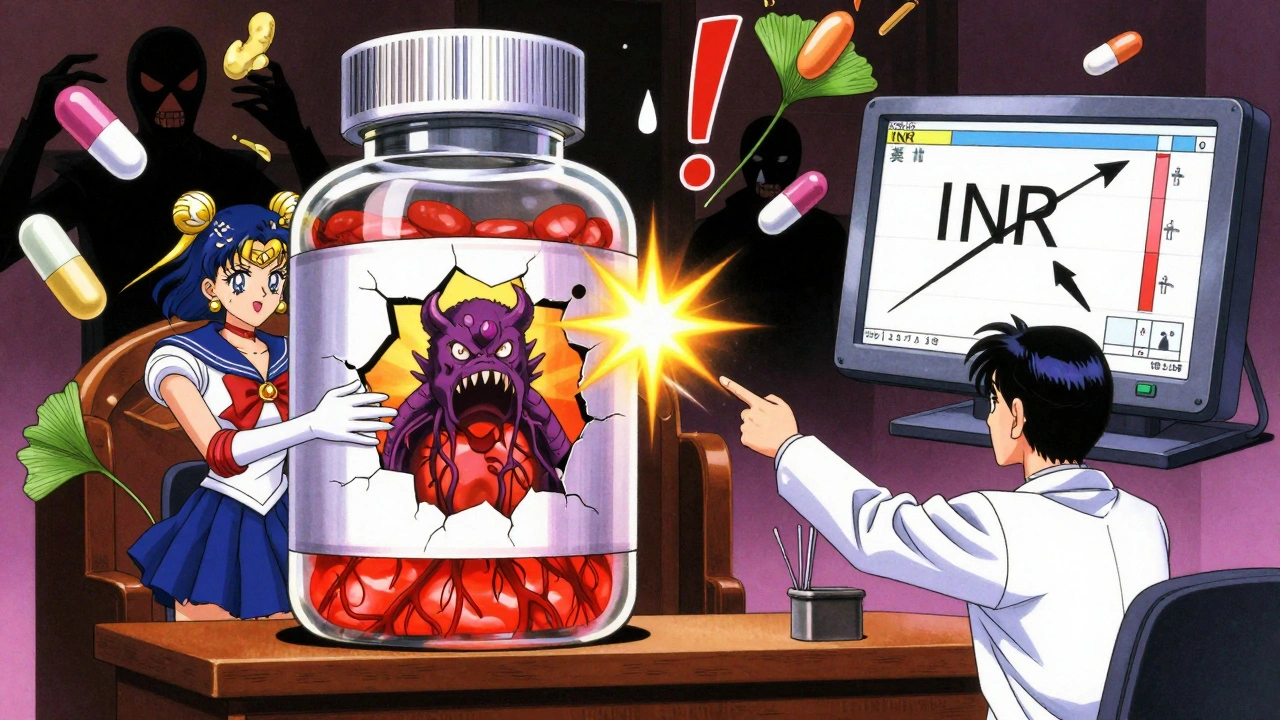
And here’s the kicker: your INR (a blood test that measures how long it takes your blood to clot) might look normal-even when garlic is doing damage. That’s because garlic affects platelets, not the clotting factors that INR measures. So you could be in danger and not know it.
What the Experts Say
Dr. Pieter Cohen from Harvard Medical School says it plainly: “I don’t know of any evidence that taking garlic supplements is better for your heart than eating garlic in food.” That’s the bottom line. The benefits you hear about-lower cholesterol, better blood pressure-can all come from real garlic in your meals. The risks only come from concentrated pills.
He also warns that garlic doesn’t just mess with blood thinners. It can raise the risk of muscle damage when taken with statins. It can cause dangerous drops in blood pressure if you’re on hypertension meds. And it’s not just garlic. Other supplements like fish oil, ginger, ginkgo, and turmeric do the same thing. But garlic? It’s one of the most dangerous because of how long its effects last.
Supplements Aren’t Regulated Like Medicine
Here’s the scary part: a garlic supplement labeled “1,000mg” might contain zero ajoene-or it might contain enough to double your bleeding risk. A 2024 analysis tested 45 different garlic supplements and found that 68% didn’t list ajoene content. The actual ajoene levels ranged from undetectable to 3.2mg per pill. That’s a 300-fold difference.
There’s no standard. No quality control. No guarantee that what’s on the label matches what’s inside. So even if you’re taking “the same dose” as someone else, your risk could be totally different.
What You Should Do
If you’re on a blood thinner and taking garlic supplements, here’s what you need to do-right now:
- Stop taking garlic supplements immediately. Don’t wait for your next appointment. The risk is real and immediate.
- Talk to your doctor or pharmacist. Tell them exactly what you’ve been taking-name, dose, how long. Don’t assume they know. Many don’t ask about supplements unless you bring it up.
- If you’re scheduled for surgery, stop at least 7 days before. This isn’t a suggestion. It’s a medical requirement. The NIH and American Society of Anesthesiologists both say seven days. Why? Because platelets affected by ajoene can’t regenerate until your body makes new ones, and that takes about a week.
- If you’ve already had surgery and bled more than expected, ask for a platelet function test. The PFA-100 test can detect if garlic is still affecting your clotting. Closure times over 193 seconds mean you’re at high risk.
- Switch to culinary garlic. One or two cloves a day in your cooking is safe. It doesn’t contain enough ajoene to cause trouble.

Monitoring Your Blood
If you’re on warfarin and you’ve been taking garlic supplements-even in the past-you need closer monitoring. The University of California San Diego recommends checking your INR within 48 to 72 hours after starting or stopping garlic. In their data from over 2,300 patients, dose adjustments of 10% to 25% were often needed.
And if you’ve had a recent bleed or are about to have surgery, your care team might also check your platelet function. That’s not a routine test, but if you’ve been on garlic supplements, it should be.
What About Other Supplements?
You’re not alone if you’re taking other herbs or vitamins with your blood thinner. But garlic isn’t the only one to watch:
- Fish oil - High doses (over 3g daily) increase bleeding risk.
- Ginkgo biloba - Linked to brain bleeds in people on warfarin.
- Ginger - Can prolong bleeding time, especially in surgery.
- Turmeric - Curcumin interferes with platelet function.
- Feverfew - Used for migraines, but also a strong antiplatelet.
None of these are “safe” just because they’re natural. The same rules apply: stop them before surgery. Tell your doctor. Don’t assume they’re harmless.
What’s Next?
Researchers are still trying to figure out the full picture. Two clinical trials are currently underway, testing how aged garlic extract (like Kyolic) interacts with apixaban. Results are expected by the end of 2024. Until then, the safest approach is simple: avoid supplements entirely if you’re on blood thinners.
The NIH case studies changed how surgeons screen patients. Now, every patient going into surgery is asked about supplements-not just prescription drugs. That’s because people don’t think of garlic pills as medicine. But they are. And they can kill you.
There’s no reason to take garlic supplements if you’re on anticoagulants. The benefits are unproven. The risks are real. And the consequences? They’re not worth it.
Katherine Rodgers
December 8, 2025 AT 23:05also my bottle said '1000mg garlic extract' but no ajoene content?? that's not a label. that's a lie.
Evelyn Pastrana
December 10, 2025 AT 10:01my grandma eats 4 cloves a day in her pasta. never had a problem. i took a pill. almost needed a transfusion.
so yeah. food good. pills bad. simple.
Arun Kumar Raut
December 10, 2025 AT 18:39my uncle is on blood thinner after stroke. he eats garlic daily. no problem. but he would never take a supplement. he says, 'if god wanted it in pill form, he would have made it in pill form'.
wise man.
Tejas Bubane
December 12, 2025 AT 11:23also, 'ajoene'? sounds like a bad sci-fi villain. who even uses that word outside a lab?
the real problem? people think supplements are medicine. they're not. they're candy with a label.
Olivia Portier
December 13, 2025 AT 01:50i stopped immediately after reading this.
thank you for writing this. i feel less alone. also, i’m telling my whole family. they’re all on meds too.
ps: i just threw out my whole bottle. it felt like detoxing from something i didn’t know was poison.
Tiffany Sowby
December 14, 2025 AT 20:37classic america.
also, why is this even a debate? if it can make you bleed out during surgery, it's a drug. classify it. regulate it. or ban it.
Jennifer Blandford
December 15, 2025 AT 02:04i've been taking garlic, fish oil, and turmeric for 'inflammation' for 5 years. my knee feels fine. but my dad died from a brain bleed last year. he was on warfarin. he took ginkgo.
i didn't know.
now i know.
i'm stopping everything. and i'm screaming this from the rooftops.
if you're on blood thinners - stop the pills. eat garlic. breathe. live.
Brianna Black
December 16, 2025 AT 09:30It is imperative that healthcare providers incorporate supplement history into standard preoperative screening protocols, as the absence of standardized labeling renders patient self-reporting inherently unreliable.
Moreover, the misconception that 'natural' equates to 'safe' remains a pervasive and dangerous public health myth.
Shubham Mathur
December 17, 2025 AT 02:15people think if it's from a plant it's fine but garlic pills are basically medicine with no testing
my cousin took them with aspirin and ended up in the er
doctors don't ask about supplements because they're too busy
but you need to tell them
your life depends on it
Stacy Tolbert
December 18, 2025 AT 18:25my doctor said i was lucky i didn't have a stroke.
so yeah. i'm alive because i read this.
thank you.
i'm deleting my supplement app now.
Ronald Ezamaru
December 19, 2025 AT 20:01patients don't think garlic pills are drugs. they think they're 'just a little something for immunity'.
they don't mention them unless you ask.
so here's what you do:
when you go to your doctor or pharmacist - tell them EVERYTHING you take. even if you think it's 'nothing'.
even if it's 'just garlic'.
because it's not just garlic. it's a chemical. and it's dangerous with your meds.
you're not being dramatic. you're being smart.