Most people don’t realize that generic drugs are the reason millions can afford their prescriptions. In 2025, nine out of every ten prescriptions filled in the U.S. are for generics. Yet, patients still hesitate. They worry the pill in the brown bottle isn’t as strong as the one in the fancy box with the logo. They remember stories from years ago-when generics were cheaper because they were less reliable. But those days are over. Today’s generics are made with the same strict standards as brand-name drugs. The active ingredient is identical. The dosage is exact. The body absorbs it the same way. So why does the doubt still exist?
Why Perception Still Lags Behind Science
The disconnect isn’t about science. It’s about psychology. Brand names carry weight. They’re advertised on TV. They’re named by marketing teams with decades of experience. When a doctor says, "Take this pill," and the patient sees "Lipitor" on the bottle, there’s comfort. When they see "atorvastatin," they wonder: Is this the same? Did they cut corners?
A 2025 survey found that 78% of physicians hear patients express concerns about generic effectiveness-even though the FDA requires bioequivalence within 80-125% of the brand-name version. That’s not a small margin. It’s a scientifically proven range where the body responds identically. Yet, patients still report feeling worse after switching. Often, it’s not the drug. It’s the expectation. The mind can make you feel side effects that aren’t there. That’s no different than believing a cheaper car won’t drive as well, even if it has the same engine.
The Rise of Complex Generics and Biosimilars
The generic market isn’t just about aspirin anymore. In 2025, the FDA approved six new biosimilars for denosumab, the drug used to treat osteoporosis and bone cancer. These aren’t simple pills. They’re complex injectables made from living cells, requiring lab conditions as precise as those for the original brand. Products like Bildyos, Aukelso, and Enoby are exact copies of Prolia and Xgeva. They’re not "similar." They’re equivalent. And they cost 15-30% less.
These aren’t niche products anymore. Hospital pharmacies are using them daily. Oncology units now rely on generic injectables to treat more patients without increasing costs. One hospital in Ohio switched 80% of its chemotherapy infusions to biosimilars last year. They saved $1.2 million. That money went toward hiring two extra nurses. Patients didn’t notice a difference in their treatment. But they noticed their care improved.
Why Price Isn’t the Whole Story Anymore
For years, the pitch was simple: "Generics save you money." That still works for some. But as prices drop, the message loses power. When a drug costs $3 instead of $30, the savings feel less urgent. People start asking: "If it’s so good, why is it so cheap?"
That’s where new approaches come in. CivicaScript, a nonprofit generic manufacturer, stopped selling to pharmacies. Instead, they partner directly with hospitals and clinics. They publish their production costs online. They show the factory floor. They explain how they avoid shortages by making drugs in the U.S. instead of relying on overseas suppliers. Their model isn’t about being the cheapest. It’s about being trustworthy.
And it’s working. Hospitals that use CivicaScript report fewer supply interruptions and higher staff confidence in the medications they give. Patients notice. When a nurse says, "This is the same drug, made right here, with no middlemen," it changes the conversation.
Technology Is Building Trust, Not Just Cutting Costs
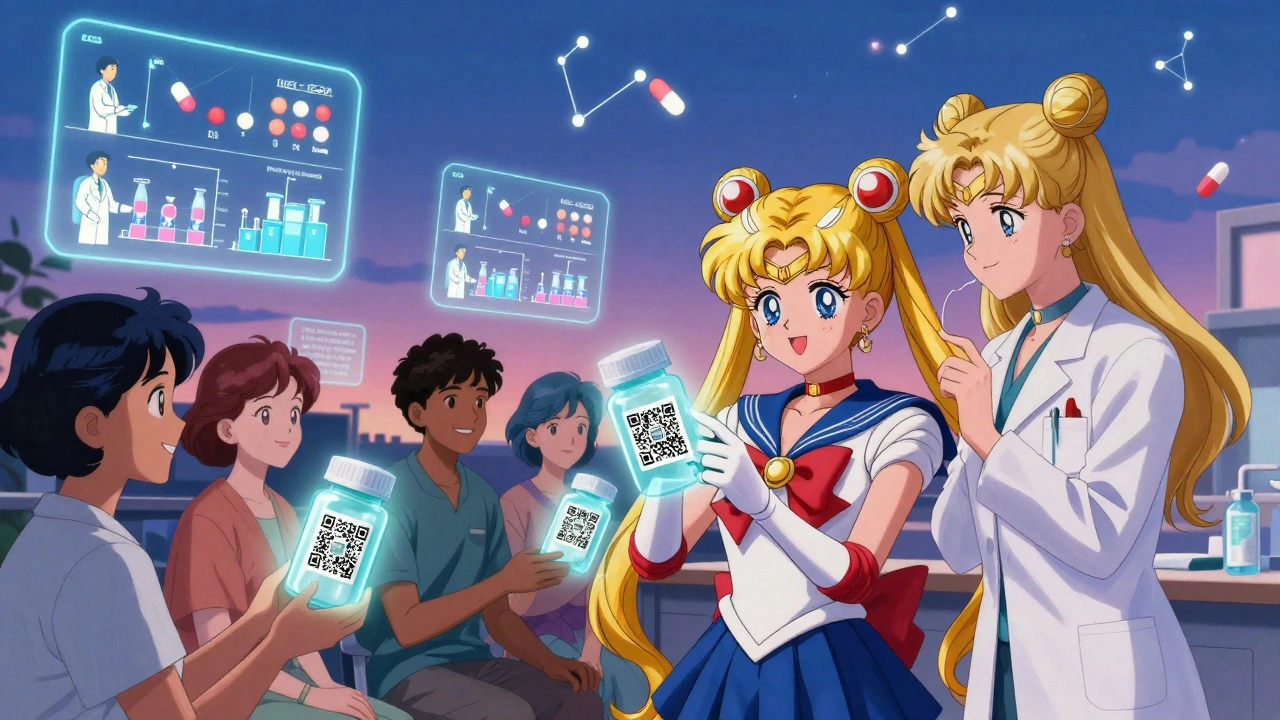
Blockchain and AI are no longer just tech buzzwords. They’re tools for transparency. A new pilot program in California uses blockchain to track every batch of generic insulin from factory to pharmacy. Patients can scan a QR code on their bottle and see the full production history: where it was made, when it was tested, who approved it. No marketing spin. Just facts.
AI is helping too. Some pharmacies now use chatbots to answer patient questions about generics in real time. Instead of waiting for a pharmacist to be free, a patient can ask, "Is this generic as good as the brand?" and get an answer backed by FDA data, clinical studies, and real patient outcomes. One study showed that after using this tool, 60% of patients who were unsure about generics changed their minds.
Education Works-But Only If It’s Done Right
Doctors are the most trusted source of health information. Yet, many still don’t talk about generics unless asked. A 2025 pilot by the American Medical Association trained 500 doctors to explain generics in plain language during appointments. Instead of saying, "It’s the same active ingredient," they said, "This pill has the same medicine as the brand, made under the same rules. It’s been used by over 10 million people with the same results. The only difference? You’ll save $25 this month."
The results? A 35% drop in patient concerns. Not because they were convinced by data. But because their doctor spoke like a human, not a textbook.
What’s Next? The Future Is in Reliability, Not Just Savings
The generic drug market is growing fast-projected to hit $728 billion by 2034. But growth alone won’t fix perception. The next big shift won’t come from lower prices. It’ll come from fewer shortages, clearer labeling, and consistent quality.
The FDA listed 270 active drug shortages in 2025. That’s down from 400 in 2020, but still too high. The fix? More domestic manufacturing. More transparency. More accountability. When a patient knows their medication won’t suddenly disappear because it was made in a factory overseas that had a power outage, trust grows.
And when patients see their doctor, their pharmacist, and their insurance plan all working together to make generics easy to get and easy to understand-then the stigma fades. Not because they’re told to believe it. But because they experience it.
Changing the Story, One Prescription at a Time
Generic drugs aren’t the underdogs anymore. They’re the backbone of modern healthcare. They keep people on their medications. They keep hospitals running. They keep families from choosing between rent and refills.
The future of generics isn’t about convincing people they’re good enough. It’s about showing them they’re better than they think. Better than the brand in terms of access. Better than the system in terms of fairness. Better than fear in terms of truth.
It’s time to stop selling them as a bargain. Start presenting them as a breakthrough.
Are generic drugs really as effective as brand-name drugs?
Yes. The FDA requires that generic drugs contain the same active ingredient, in the same strength, and work the same way in the body as the brand-name version. They must meet the same strict standards for purity, stability, and absorption. Bioequivalence studies prove they deliver the same clinical results. Thousands of studies over decades confirm this. If a generic drug didn’t work the same, it wouldn’t be approved.
Why do some people feel worse after switching to a generic?
Often, it’s not the drug-it’s the expectation. People associate the brand’s packaging, color, or shape with effectiveness. When they switch to a different-looking pill, even if it’s identical, they may notice side effects that weren’t there before. This is called the nocebo effect. It’s real, but it’s psychological, not chemical. Studies show that when patients are properly informed about the switch, these symptoms drop significantly.
What’s the difference between a generic drug and a biosimilar?
Generics are exact copies of small-molecule drugs, like pills for high blood pressure or cholesterol. Biosimilars are highly similar versions of complex biological drugs, like injectables for cancer or autoimmune diseases. Because biological drugs are made from living cells, biosimilars can’t be 100% identical-but they’re proven to have no meaningful clinical difference. Biosimilars are more expensive to make than traditional generics, but still cost 15-30% less than the original.
Why are generic drugs so much cheaper?
Brand-name companies spend billions on research, clinical trials, and marketing. Generic manufacturers don’t have to repeat those expensive steps. They only need to prove their version works the same. That cuts costs dramatically. A typical generic saves 80-85% compared to the brand. That’s why generics make up 90% of prescriptions but only 12% of total drug spending in the U.S.
Can I trust generics made overseas?
The FDA inspects all manufacturing facilities-whether in the U.S., India, or elsewhere-using the same standards. A 2025 report found that over 70% of generic drug ingredients come from overseas, but nearly all facilities pass FDA inspections. The bigger issue isn’t location-it’s supply chain stability. Companies like CivicaScript are building U.S.-based production to reduce the risk of shortages. When you know your drug is made in a reliable, inspected facility, the country of origin matters less than the proof of quality.
Will generic drugs become more expensive in the future?
Experts predict prices will stabilize, not rise. As more manufacturers enter the market and production becomes more efficient, competition keeps prices low. But as drugs get more complex-like biosimilars and specialty injectables-the cost to make them increases. That means some generics may cost more than simple pills, but they’ll still be far cheaper than the brand. The goal isn’t to make them dirt cheap. It’s to make them fair, reliable, and accessible.
Chelsea Moore
December 3, 2025 AT 17:15Wow. Just... wow. I can't believe people still fall for this. Generics? Please. I switched to one last year for my blood pressure meds and woke up feeling like a zombie for three weeks. My doctor said it was 'all in my head'-like I'm just some hysterical woman who can't tell the difference between a real drug and a placebo made in a basement in India. I'm not crazy. I'm just not stupid.
John Biesecker
December 4, 2025 AT 12:23man i love how science and psychology collide here 🤯 like, the pill is literally the same but our brains are wired to think fancy packaging = better. it’s like buying a nike shoe vs a generic one that’s identical in materials but you just *feel* like you’re running slower. also, i had no idea civica is doing that transparency thing-kinda beautiful tbh
Genesis Rubi
December 4, 2025 AT 14:15Let me get this straight-Americans are scared of generic drugs made overseas but think our military-industrial complex is flawless? 🤡 We import 70% of our active ingredients and still act like we're the only country that knows how to make medicine? We need more U.S.-made drugs, not more brainwashing about 'bioequivalence.' This is just globalist propaganda dressed up as science.
Doug Hawk
December 6, 2025 AT 03:28Interesting framework here. The core issue isn't bioequivalence-it's epistemic trust. Patients don't distrust the pharmacology, they distrust the system that commodifies health. The brand-name illusion functions as a heuristic for reliability. When you remove the brand, you remove the psychological safety net. The blockchain pilot is promising because it externalizes verification. But unless you address the structural alienation in healthcare delivery, transparency alone won't fix the nocebo effect. Also, the 80-125% range isn't a margin-it's a biological tolerance zone. The body doesn't care about the label.
Shubham Pandey
December 7, 2025 AT 23:32generics work. stop overthinking
Paul Santos
December 8, 2025 AT 04:33Ah, the noble quest to democratize pharmaceuticals-how quaint. The real tragedy isn't patient perception, it's the commodification of health as a transactional good. Biosimilars are the future, yes, but only if we stop pretending that cost-efficiency equates to ethical progress. The real innovation isn't in manufacturing-it's in reimagining healthcare as a right, not a marketplace. 🤔
Eddy Kimani
December 8, 2025 AT 21:45This is the most hopeful thing I’ve read all year. The CivicaScript model? That’s the blueprint. Transparency isn’t just a buzzword-it’s the antidote to fear. When patients see the actual lab reports, the QA logs, the batch numbers-it stops being a mystery and becomes a partnership. And the AI chatbots? Game changer. We’re not just lowering costs-we’re rebuilding trust, one scan at a time. 🚀
John Morrow
December 9, 2025 AT 09:32Let’s be brutally honest: the entire generic drug narrative is a corporate shell game. The FDA’s bioequivalence standards are laughably lenient. That 80-125% window? That’s a 45% variance. Two patients taking the same generic could be getting doses that differ by nearly half. And the 'same active ingredient' claim ignores excipients-fillers, binders, dyes-that can trigger immune responses. The fact that hospitals are switching to biosimilars? That’s not progress. That’s desperation. They’re cutting corners because insurance won’t pay for the brand. This isn’t science-it’s rationing dressed up as innovation.
Kristen Yates
December 11, 2025 AT 01:25I used to be scared of generics too. Then my mom got on one for her thyroid. She didn’t feel any different. She saved $40 a month. That money went to her grandkids’ Christmas presents. No drama. No side effects. Just a pill that worked. Sometimes the simplest truths are the ones we forget.
Saurabh Tiwari
December 11, 2025 AT 17:17bro the real story is how cheap these drugs are now and how little people know about it 🤷♂️ i mean like i get why people worry but also like… its the same chemistry. why are we still talking about this in 2025? also the blockchain thing is actually kinda cool
Michael Campbell
December 11, 2025 AT 23:40They’re lying. The FDA is owned by Big Pharma. The ‘same standards’? That’s a myth. The labs that test generics? Mostly outsourced to the same countries that make the pills. And don’t get me started on the ‘no difference’ studies-funded by the same companies that profit from the brand names. This is a controlled narrative. They want you scared of paying more so you’ll take the cheap poison and stay quiet.
Victoria Graci
December 12, 2025 AT 13:39It’s wild how we treat medicine like it’s a luxury brand. We name our dogs after pharmaceuticals-Lipitor, Zoloft-and yet we don’t trust the same molecule just because it’s in a plain bottle. It’s like refusing to eat a homemade pie because it’s not in a fancy ceramic dish. The truth? The body doesn’t care about logos. It cares about molecules. And if your body responds the same, then the story you tell yourself is the only thing that’s different. We’re not broken by science-we’re broken by marketing.
Saravanan Sathyanandha
December 12, 2025 AT 16:40The cultural dimension of trust in medication is profoundly underexplored. In many communities, especially in developing nations, the perception of generics is not rooted in skepticism but in necessity. Yet, when these same drugs are introduced in Western contexts, they are met with suspicion. This reveals a deeper epistemic hierarchy: that ‘Western-made’ equals ‘trustworthy,’ regardless of evidence. The CivicaScript model succeeds not because it is cheaper, but because it re-centers community agency. Transparency is not a feature-it is an act of justice.
alaa ismail
December 14, 2025 AT 00:57just tried a generic for my anxiety meds. felt the same. saved $50. no drama. maybe we should all chill out a bit
ruiqing Jane
December 15, 2025 AT 10:39Every single person who says ‘I felt worse after switching’-I hear you. But let’s not let fear silence progress. The science is clear. The data is overwhelming. And the human cost of not using generics? Millions go without meds because they can’t afford the brand. We owe it to those people to keep pushing for truth, clarity, and access. This isn’t about marketing. It’s about mercy.