
Why Doctors Need Ongoing Training on Generic Drugs
Generic drugs make up over 90% of all prescriptions filled in the U.S. But only about 23% of total drug spending goes to them. That’s not because they’re cheaper to make-it’s because doctors still hesitate to prescribe them. Why? Many don’t fully understand how generics work, or they worry about patient skepticism. Continuing medical education (CME) is meant to fix that. Yet most CME programs still treat generics as an afterthought, not a core competency.
The truth is, prescribing generics isn’t just about saving money. It’s about improving adherence. Studies show patients are 23.7% more likely to stick with their medication when it’s a generic. That’s not a small boost-it’s the difference between a chronic condition being controlled and spiraling out of hand. And with the FDA approving over 1,000 new generics in 2023 alone, doctors can’t afford to rely on what they learned in med school.
What CME Requirements Actually Look Like Today
CME rules vary wildly by state. In California, doctors need 50 hours of Category 1 CME every two years. But nowhere does it say those hours must cover generics. In Maryland, there’s a requirement for half an hour on prescription drug monitoring programs-but still nothing specific to generic equivalency. Only 42 out of 50 states even require doctors to know the difference between brand and generic names.
Meanwhile, 32 states now demand opioid prescribing education. That’s progress. But the MATE Act, which took effect in June 2023, is the first federal rule that explicitly ties generics to controlled substances. All DEA-registered providers must complete eight hours of training on substance use disorders-and that includes learning when generic alternatives are appropriate for opioids, benzodiazepines, and other high-risk drugs.
Some states are catching up. California updated its rules in January 2024 to include two hours on biosimilars-complex, biologic-based generics that behave like brand-name drugs but are harder to replicate. That’s a sign the system is evolving. But for most doctors, CME still feels like a checkbox, not a tool.
The Science Behind Generic Equivalence
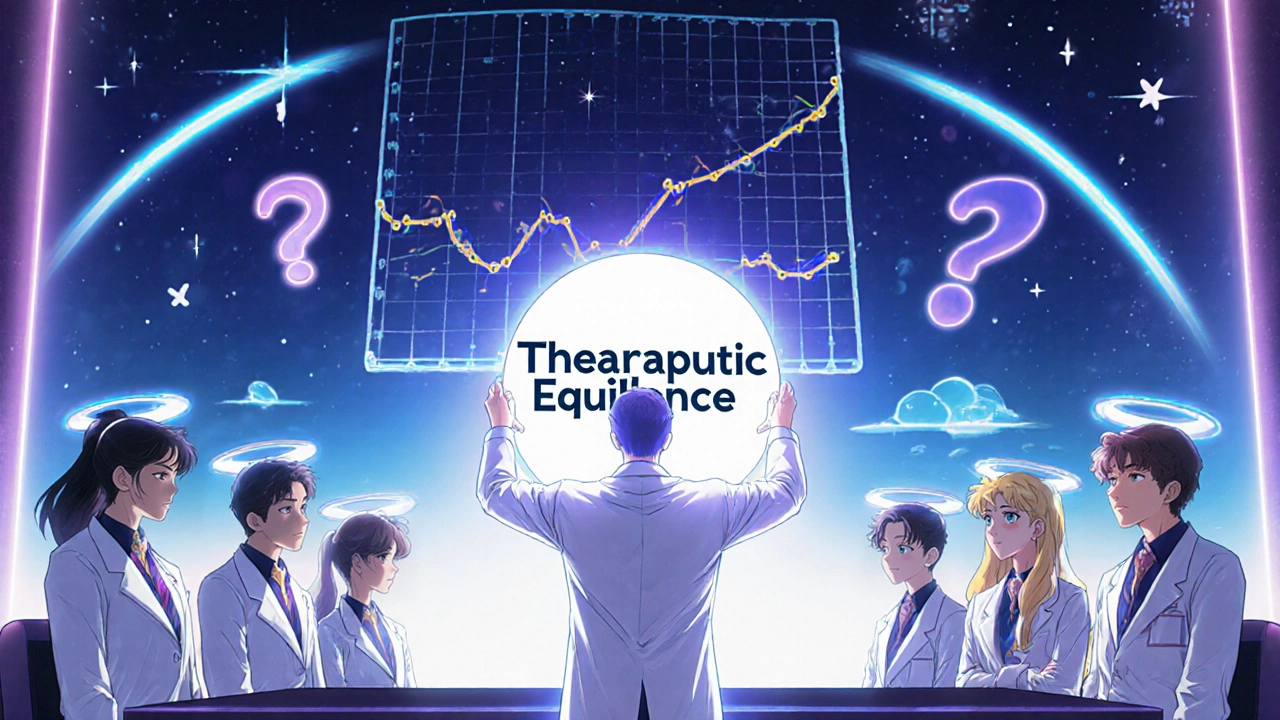
The FDA doesn’t approve generics lightly. Every generic must prove it’s bioequivalent to the brand-name drug-meaning it delivers the same amount of active ingredient into the bloodstream at the same rate. The agency uses the Orange Book to list which generics are rated as therapeutically equivalent. That’s the gold standard.
But not all drugs are created equal. For medications with a narrow therapeutic index-like warfarin, levothyroxine, or phenytoin-small differences in absorption can matter. That’s why some doctors still default to brand names. And they’re not wrong to be cautious. A 2023 study in Health Affairs found that in rare cases, switching generics can trigger instability in these drugs. But the fix isn’t to avoid generics-it’s to learn how to manage the switch.
Doctors who complete targeted pharmacology CME show a 17.3% improvement in choosing the right generic. That’s not magic. It’s knowledge. They learn to read the Orange Book. They understand why a generic might have different inactive ingredients. They know when to monitor labs after a switch. That’s the kind of training that changes practice.
What Works in Real-World CME
Most CME modules are boring. A 12-hour lecture on pain management? Irrelevant to a radiologist. A generic drug quiz that doesn’t connect to daily decisions? Easy to skip.
But some programs are changing that. UpToDate, for example, now gives 0.5 CME credits just for reading a drug monograph during patient care. That’s smart. It turns learning into part of the workflow. Doctors don’t have to log in to a portal-they learn while they chart.
Another winner? The RenewNowCE pharmacology course that includes real patient scenarios: “Your 68-year-old patient is on levothyroxine. The pharmacy substituted a generic. Her TSH went from 2.1 to 5.8. What do you do?” That’s the kind of question that sticks. One California family doctor said her patients’ concerns about generics dropped 40% after she used this training to explain bioequivalence clearly.
Doctors who use digital platforms-like Medscape, WebMD, or Epic-integrated tools-are 47% more likely to finish their CME. Mobile access, bite-sized modules, and real-time feedback make the difference.
The Gap Between Knowledge and Practice
Here’s the problem: even when doctors complete the CME, they don’t always apply it. A 2022 study in Academic Medicine found physicians completed only 68% of required pharmacology modules-compared to 87% for clinical topics. Why? Because pharmacology feels abstract. It doesn’t always connect to what they see in the exam room.
But the data shows it should. In 2023, the RAND Corporation estimated that if all U.S. doctors prescribed generics whenever appropriate, the healthcare system could save $156 billion a year. That’s not a theoretical number. It’s real money-money that could fund mental health services, reduce patient copays, or cover insulin for those who can’t afford it.
And patients notice. On physician forums, 68% of doctors say CME on generics made them more confident in prescribing them. But 32% still feel it’s irrelevant to their specialty. A radiologist asked: “Why should I care about generic contrast agents?” The answer: because some are generic now. And if your patient gets a cheaper, equally effective version, you’re doing your job better.

What’s Next for Generics Education
The future of CME isn’t hours. It’s outcomes. The National Academy of Medicine is testing competency-based models in 12 states. Instead of requiring 50 hours, they’ll test whether a doctor can correctly identify a therapeutically equivalent generic from the Orange Book-or explain why a switch might fail in a patient with epilepsy.
AI is coming too. McKinsey predicts that by 2027, CME platforms will analyze a doctor’s prescribing habits and serve up personalized modules. If you prescribe 80% brand-name statins? The system will push you a module on generic alternatives. If you rarely prescribe generics for diabetes? It’ll show you data on adherence rates.
And with 59 new molecular entities approved in 2023, the pipeline of generics is only growing. Doctors who don’t keep up won’t just be out of compliance-they’ll be prescribing more expensively, less effectively, and less equitably.
How to Get Started Today
- Check your state’s CME rules. Use the Federation of State Medical Boards’ website to see if your state has specific pharmacology or generics requirements.
- Look for ACCME-accredited courses. Over 300 providers offer pharmacology-focused content. Filter for ones that mention the Orange Book, bioequivalence, or therapeutic equivalence.
- Use free FDA tools. The FDA’s Orange Book Primers are updated quarterly and available at no cost. They’re short, clear, and practical.
- Ask your EHR vendor. Does your electronic health record integrate with UpToDate or Medscape? If so, you’re already getting CME credits during patient care.
- Start small. Pick one drug class you prescribe often-like ACE inhibitors or SSRIs-and learn the top three generic options. Know their bioequivalence ratings. Know why they’re interchangeable.
Final Thought: It’s Not About Cost-It’s About Care
Doctors don’t resist generics because they’re skeptical of science. They resist because they’re skeptical of systems that don’t give them the tools to do it right. CME that’s disconnected from practice doesn’t help. But CME that’s tied to real decisions-patient outcomes, cost savings, adherence rates-does.
The goal isn’t to replace brand-name drugs. It’s to ensure every prescription, whether generic or brand, is the right one. And that starts with knowledge that’s current, clear, and clinically relevant.
Do all generics work the same as brand-name drugs?
The FDA requires generics to be bioequivalent to brand-name drugs, meaning they deliver the same active ingredient at the same rate and amount. For most medications, this means they work identically. But for drugs with a narrow therapeutic index-like warfarin, levothyroxine, or phenytoin-small differences in absorption can matter. That’s why doctors need to monitor patients closely after switching and understand the Orange Book’s therapeutic equivalence ratings.
Is CME on generics mandatory for all doctors?
No, not universally. Only 42 states require physicians to demonstrate knowledge of generic vs. brand-name nomenclature. But the MATE Act, effective June 2023, now requires all DEA-registered practitioners to complete eight hours of training on substance use disorders-including education on generic alternatives to controlled substances. This is the first federal mandate directly tying generics to CME.
Why do some doctors still prefer brand-name drugs?
Some doctors worry about patient concerns, inconsistent pharmacy substitutions, or rare cases where switching triggers instability-especially with narrow therapeutic index drugs. Others simply haven’t received clear training on how to evaluate generics. Studies show that doctors who complete targeted pharmacology CME are significantly more confident in prescribing generics and see better patient adherence as a result.
How can I find good CME courses on generics?
Look for courses accredited by the Accreditation Council for Continuing Medical Education (ACCME) that specifically mention bioequivalence, the FDA Orange Book, or therapeutic equivalence. Platforms like UpToDate, Medscape, and RenewNowCE offer practical, case-based modules. Free resources like the FDA’s Orange Book Primers are also excellent starting points.
Will AI change how doctors learn about generics in the future?
Yes. By 2027, AI-driven CME platforms will analyze a doctor’s prescribing patterns and deliver personalized learning. If you rarely prescribe generics for hypertension, the system will recommend modules on alternatives like lisinopril or hydrochlorothiazide. This shift from hour-based to outcome-based learning will make CME more relevant and effective.
Justina Maynard
November 29, 2025 AT 06:59Let’s be real-most CME modules on generics are just glorified PowerPoint slides with a quiz at the end. I’ve sat through three of them. Zero practical takeaways. But the RenewNowCE case study? That one stuck. I actually used it last week with a patient on levothyroxine who was convinced the generic was ‘watered down.’ Showed her the Orange Book data, explained bioequivalence in plain terms, and now she’s refill-ready. Knowledge isn’t power unless you can hand it to someone like a flashlight in the dark.
Evelyn Salazar Garcia
November 29, 2025 AT 13:35Generic drugs are a government scam to make big pharma look bad.
Clay Johnson
November 30, 2025 AT 02:06The real issue isn’t education-it’s the erosion of clinical autonomy. When prescribing becomes a checklist governed by databases and algorithms, we stop being physicians and start being data-entry clerks with stethoscopes.
Jermaine Jordan
December 1, 2025 AT 09:17This isn’t just about saving money-it’s about justice. Every time a doctor prescribes a brand-name drug when a generic is just as effective, they’re charging a patient more than they should. That’s not medicine. That’s exploitation dressed in white coats. We owe our patients better. And we owe ourselves the courage to lead the change.
Chetan Chauhan
December 1, 2025 AT 12:59generic drugs r just copycats man. how can u trust sumtin that costs 10%? the brand name ones r made in usa. generics r made in china or india. u think they care bout ur health? lol
Phil Thornton
December 2, 2025 AT 16:44My pharmacy swaps my meds without telling me. I don’t care if it’s ‘bioequivalent’-I want consistency. If I feel different, it’s not in my head. It’s in my body.
Pranab Daulagupu
December 4, 2025 AT 08:01Therapeutic equivalence isn’t just a regulatory term-it’s a clinical imperative. For high-risk meds, the Orange Book is the only reliable compass. We need to train residents to read it like scripture.
Barbara McClelland
December 4, 2025 AT 12:34Start small. Pick one drug you prescribe often. Learn the top three generics. Know their equivalence ratings. Talk to your pharmacist. That’s how you build confidence-not by sitting through a 12-hour lecture. One step at a time. You got this.
Alexander Levin
December 5, 2025 AT 21:36AI-driven CME? Sounds like Big Pharma’s next surveillance tool. They’ll track your prescribing habits, then push you toward generics that benefit their bottom line. Wake up.
Ady Young
December 7, 2025 AT 11:44I’ve been using UpToDate during patient visits for months now. Got my CME credits without logging into a separate portal. It’s seamless. And honestly? I’ve started prescribing more generics because I actually understand the data now-not just the buzzwords. Small changes, big impact.
Matthew Stanford
December 8, 2025 AT 18:48As someone who works with immigrant patients who often can’t afford brand names, this is personal. I’ve seen people skip doses because the copay’s too high. When I switch them to a generic they can afford, they show up for follow-ups. That’s not data. That’s humanity. CME should be about that-not just compliance.
farhiya jama
December 10, 2025 AT 05:27I read this whole thing and now I feel emotionally drained. Why does everything have to be so complicated? Can’t we just trust doctors to do what’s right without all this bureaucracy?