Heart Medication Interaction Checker
Check Your Medication Combinations
Enter medications and substances you're taking. This tool checks for dangerous combinations based on the article content.
Dangerous Interaction Detected
Safe Combination
When you’re managing heart disease, it’s common to take several medications at once. Maybe it’s a beta blocker for your blood pressure, a statin for cholesterol, a diuretic to reduce swelling, and an anticoagulant to prevent clots. But here’s the thing: combining multiple heart medications isn’t just adding pills-it’s playing Russian roulette with your health if you don’t know the risks.
One in every three people over 65 takes five or more prescription drugs. For heart patients, that number jumps even higher. And with each extra pill, your chance of a dangerous drug interaction grows. A 2019 study found that people taking just two heart medications had a 13% risk of a harmful interaction. If you’re on four? That jumps to 38%. Seven or more? It’s over 80%. These aren’t rare edge cases. They’re everyday dangers.
Why Heart Medications Are Especially Risky
Heart drugs work in tight, delicate systems. A tiny change in how much of a drug is in your bloodstream can mean the difference between protection and disaster. Many of these medications are processed by the same liver enzymes-especially CYP3A4. When two drugs use the same pathway, they fight for space. One can block the other from being broken down, causing toxic buildup. Or one can speed up the breakdown, making the drug useless.
Take statins, for example. These cholesterol-lowering drugs are among the most prescribed in the world. But if you drink grapefruit juice-just one quart a day-you’re in trouble. Grapefruit blocks the CYP3A4 enzyme in your gut. That means your body can’t clear the statin properly. Levels spike. Muscle damage (rhabdomyolysis) can follow. Kidneys can fail. The FDA says this isn’t theoretical. It’s happened. And it doesn’t take much. One glass won’t kill you, but daily consumption? That’s a slow-motion emergency.
Unsafe Combinations You Need to Avoid
Some drug pairs are outright dangerous. Here are the ones that kill people every year:
- Statin + grapefruit juice: As above. Even small amounts daily can push statin levels into toxic range. Avoid entirely if you’re on atorvastatin, simvastatin, or lovastatin.
- St. John’s wort + any heart medication: This herbal supplement speeds up liver metabolism. It can slash the effectiveness of blood thinners like warfarin, beta blockers, and even some anti-arrhythmics. You think you’re protected? You’re not.
- Black licorice + blood pressure meds: Natural licorice contains glycyrrhizin, which acts like a mineralocorticoid. It causes sodium retention, potassium loss, and spikes blood pressure. If you’re on a calcium channel blocker or beta blocker, this can undo all your hard work-and push your heart into arrhythmia.
- NSAIDs (ibuprofen, naproxen) + blood pressure or heart failure drugs: These common painkillers reduce kidney blood flow. That makes diuretics and ACE inhibitors less effective. Worse, they can cause sudden kidney injury and fluid retention, worsening heart failure. A 2022 study showed NSAID use in heart patients doubled the risk of hospitalization.
- Antidepressants + MAO inhibitors + aged cheese or cured meats: This combo can trigger a hypertensive crisis. Tyramine in aged cheese, salami, or soy sauce builds up when MAOIs block its breakdown. Blood pressure can rocket to stroke-level readings in minutes.
- Alcohol + any heart medication: Alcohol doesn’t just dull your senses. It lowers blood pressure, slows heart rate, and interferes with drug metabolism. When mixed with beta blockers, it can cause dangerous drops in heart rate. With diuretics, it worsens dehydration. With anticoagulants, it increases bleeding risk. The National Institute on Alcohol Abuse and Alcoholism says alcohol interacts with over 150 medications. Heart drugs are among the most dangerous.
Over-the-Counter Pills That Are Hidden Risks
You wouldn’t think a cold medicine or antacid could hurt your heart. But they do.
- Decongestants (pseudoephedrine, phenylephrine): These are in nearly every cold and allergy pill. They constrict blood vessels. That raises blood pressure-exactly what you’re trying to avoid if you have heart disease.
- First-generation antihistamines (diphenhydramine, chlorpheniramine): Found in sleep aids and allergy meds, these can prolong the QT interval on your ECG. That’s a rhythm disturbance that can trigger sudden cardiac arrest, especially if you’re already on drugs like amiodarone or sotalol.
- Antacids (Tums, Maalox): These can bind to heart medications like digoxin or certain antibiotics, preventing absorption. You take your pill. It does nothing. Your condition worsens. You don’t know why.
These aren’t rare. They’re in your medicine cabinet right now.
What’s Actually Safe? And How to Reduce Risk
Not all combinations are bad. Some are carefully designed. For example, a beta blocker and an ACE inhibitor together are standard for heart failure. But safety depends on dosage, timing, and your body’s unique chemistry.
Here’s how to protect yourself:
- Use one pharmacy. All your prescriptions-prescription, OTC, supplements-should go through the same pharmacy. They have systems that flag interactions. If you split prescriptions across pharmacies, those systems can’t see the full picture.
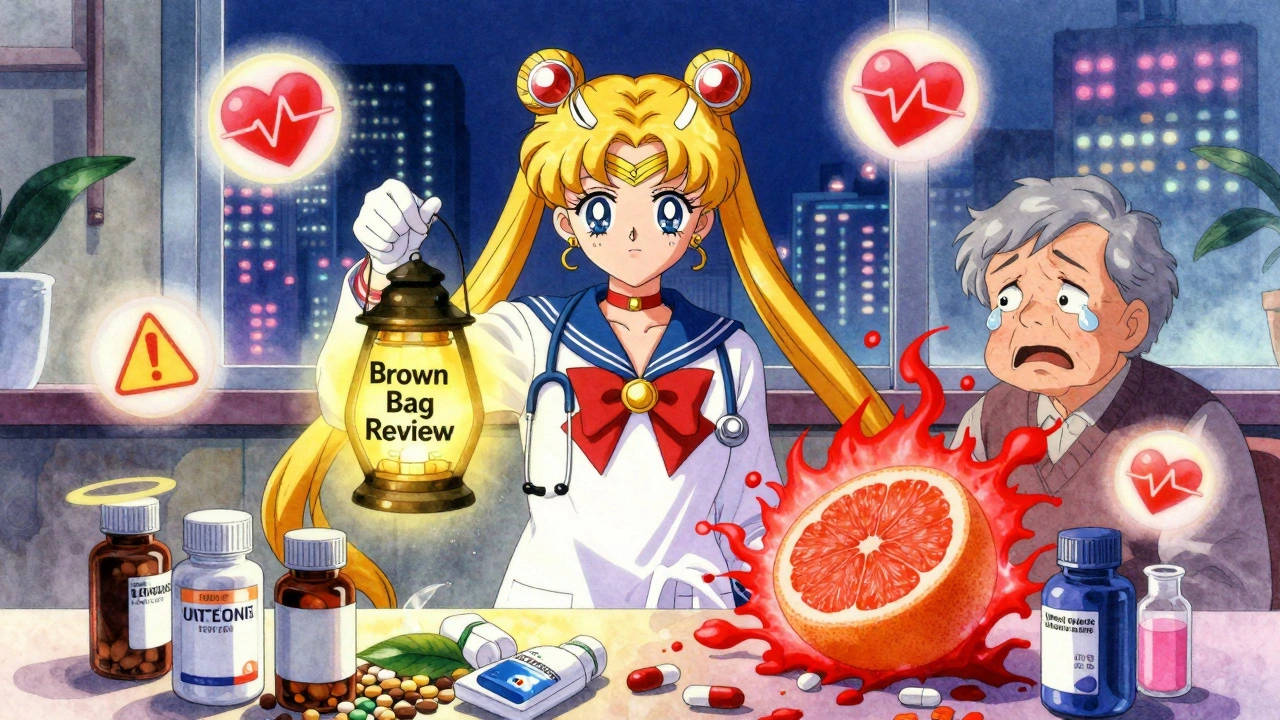
- Do a brown bag review. Every six months, bring every pill, capsule, gummy, and herbal bottle you take to your doctor. Don’t leave anything out. Not even the turmeric capsules or the melatonin you take for sleep. Many patients forget supplements, but they’re often the culprit.
- Know your meds. Don’t just take the pill. Know what it’s for. Ask your pharmacist: “What should I avoid while taking this?” Write it down.
- Check for alternatives. If you’re on simvastatin and love grapefruit, ask if atorvastatin or rosuvastatin might work instead. They’re less affected by grapefruit. If you need pain relief, ask about acetaminophen instead of ibuprofen.
- Monitor symptoms. Unexplained fatigue, muscle pain, dizziness, swelling in your ankles, or irregular heartbeat? These aren’t just “getting older.” They could be signs of a drug interaction. Call your doctor immediately.
Why Technology Isn’t Enough
Most doctors use electronic health records with built-in interaction alerts. Sounds good, right? But here’s the truth: those systems miss about 23% of serious interactions. Why? Because they don’t know your full supplement list. They don’t know if you drink grapefruit juice every morning. They don’t know if you took an OTC painkiller last week.
Algorithms are tools, not guardians. Your awareness is the real shield.
Deprescribing: The Hard but Necessary Conversation
Many older heart patients are on more drugs than they need. A 2022 study in The Oncologist found that cancer patients on multiple medications often took pills that no longer helped-and only added risk. The same applies to heart disease.
“Deprescribing”-safely reducing or stopping unnecessary meds-is one of the most effective ways to prevent interactions. But it’s emotionally hard. Patients fear stopping a pill will make them sicker. They think their doctor is giving up on them.
That’s a myth. Deprescribing isn’t quitting. It’s optimizing. It’s saying: “We’ve done enough. Now let’s keep you safe.”
If you’re on seven or more medications, ask your doctor: “Which of these are absolutely essential? Could any be stopped or replaced?” Don’t wait for a crisis. Start the conversation now.
The Bottom Line
Heart medications save lives. But they can also kill if combined carelessly. The risk isn’t in taking multiple drugs-it’s in taking them without understanding how they interact. Grapefruit juice, herbal supplements, OTC painkillers, even a glass of wine-these aren’t harmless extras. They’re potential triggers.
You don’t need to be a pharmacist to stay safe. You just need to be informed. Keep a list. Talk to your pharmacist. Ask questions. Don’t assume anything is harmless. Your heart is worth that much attention.
Can I drink grapefruit juice if I take a statin?
No, if you’re taking simvastatin, atorvastatin, or lovastatin. Grapefruit juice blocks the enzyme that breaks down these statins, causing dangerous buildup in your blood. Even one quart a day can increase levels by 47%. Switch to orange juice or avoid citrus entirely. Some statins like pravastatin and rosuvastatin are safer with grapefruit, but always check with your doctor first.
Is it safe to take ibuprofen with blood pressure medication?
Not usually. Ibuprofen and other NSAIDs can reduce the effectiveness of ACE inhibitors, beta blockers, and diuretics. They can also cause fluid retention, raise blood pressure, and damage kidneys-especially in people with heart failure. Use acetaminophen instead for pain relief, and only if approved by your doctor.
Can I take St. John’s wort with my heart pills?
No. St. John’s wort speeds up liver metabolism and can make heart medications like warfarin, beta blockers, and anti-arrhythmics less effective. This can lead to blood clots, uncontrolled heart rate, or stroke. It’s not worth the risk. Talk to your doctor about safer alternatives for mood support.
What over-the-counter medicines should I avoid with heart disease?
Avoid decongestants (pseudoephedrine), first-generation antihistamines (diphenhydramine), NSAIDs (ibuprofen, naproxen), and antacids if you’re on digoxin or other cardiac drugs. These can raise blood pressure, trigger arrhythmias, reduce drug effectiveness, or cause kidney injury. Always read labels and ask your pharmacist before taking anything new.
How do I know if I’m having a dangerous drug interaction?
Watch for sudden changes: unexplained muscle pain or weakness (could be statin toxicity), swelling in legs or ankles (fluid retention), dizziness or fainting (low blood pressure), irregular heartbeat, or extreme fatigue. If you notice any of these after starting a new pill or supplement, contact your doctor immediately. Don’t wait.
Should I stop taking my heart meds if I start a new supplement?
Never stop a heart medication without talking to your doctor. But do stop the supplement immediately and inform your provider. Some supplements can cause rapid, dangerous changes. Your doctor may need to adjust your heart meds or run blood tests to check levels. Never guess-get professional advice.
What to Do Next
Take out your pill bottles right now. Lay them out. Write down every name, dose, and reason you take it. Include vitamins, herbs, and OTC meds. Then, schedule a 15-minute appointment with your pharmacist or doctor. Bring the list. Ask: “Are any of these combinations risky?”
That’s not being paranoid. It’s being smart. Your heart doesn’t care if you meant well. It only responds to what’s actually in your system. Make sure it’s safe.
Arun kumar
December 2, 2025 AT 05:08man i just realized i been drinkin grapefruit juice with my simvastatin for years... guess thats why my muscles felt like jelly last winter. time to switch to orange juice or just quit citrus entirely. thanks for the wake up call.
Zed theMartian
December 4, 2025 AT 02:44Oh wow. Another ‘common sense’ article from someone who clearly thinks pharmacology is a cult and we’re all just dumb peasants shoveling pills into our mouths like it’s a buffet at a nursing home. Let me guess-you also think vaccines are ‘chemtrails for your arteries’? I mean, sure, grapefruit juice is bad with statins. But you act like every single person on earth is a walking pharmacokinetic disaster waiting to happen. Newsflash: people have been combining meds for decades. Most don’t die. Some even live to 90. Chill out, Dr. Doom.
ATUL BHARDWAJ
December 4, 2025 AT 10:14One pharmacy only. Brown bag every six months. Ask pharmacist. Simple. Done.
Most people dont even know what their pills are for. That is the real problem.
Steve World Shopping
December 6, 2025 AT 08:13The pharmacodynamic interplay between CYP3A4 substrates and furanocoumarin-containing citrus derivatives is a well-documented phenomenon in clinical pharmacology literature. The inhibition of first-pass metabolism leads to non-linear pharmacokinetics, significantly elevating plasma concentrations of statins-particularly simvastatin-thereby increasing the risk of rhabdomyolysis. Concurrent use of NSAIDs exacerbates renal hypoperfusion in patients with compromised cardiac output, creating a dangerous triad of cardiorenal syndrome, fluid overload, and drug toxicity. Deprescribing protocols must be guided by Beers Criteria and STOPP/START tools to mitigate polypharmacy-related morbidity.
Rebecca M.
December 8, 2025 AT 01:33So let me get this straight… you’re telling me I can’t have my morning grapefruit smoothie, my ibuprofen for the back pain, my ‘natural’ St. John’s wort for ‘mood support,’ AND my nightly glass of wine? Wow. I guess I’ll just… die. Or maybe I’ll just stop reading articles like this and keep living my life. You sound like someone who thinks a pill is a crime against nature.
Jay Everett
December 9, 2025 AT 16:49THIS. This is the kind of post that saves lives. 🙏
I’m a nurse and I’ve seen too many people come in with kidney failure because they took Advil with their blood pressure med. Or muscle pain so bad they couldn’t walk because they kept eating grapefruit with their statin. One guy thought ‘natural’ meant ‘safe’-took St. John’s wort with warfarin and ended up in the ER with a clot.
Do the brown bag. Talk to your pharmacist. They’re not just the people who hand you the pills-they’re your secret weapon. And yeah, even that ‘harmless’ melatonin? Could mess with your heart rhythm if you’re on amiodarone.
Don’t be that person who waits until they’re in the hospital to ask ‘what did I do wrong?’
Write it down. Ask. Repeat. Your heart will thank you.
Jack Dao
December 11, 2025 AT 12:02It’s not about ‘risk’-it’s about responsibility. People treat their hearts like a car they can throw random fluids into and hope it runs. You wouldn’t put diesel in a gasoline engine. Why do you think mixing random supplements with prescription meds is okay? You’re not ‘being natural,’ you’re being reckless. And if you think your ‘wellness influencer’ knows more than a pharmacist? You’re not just ignorant-you’re dangerous.
Laura Baur
December 12, 2025 AT 00:30I find it profoundly disturbing how casually people dismiss the notion of pharmacological safety as ‘fearmongering.’ The human body is not a sandbox. It is an exquisitely regulated biochemical ecosystem, and every molecule introduced-whether synthetic, botanical, or dietary-interacts with its homeostatic architecture. The CYP450 system is not a suggestion; it is a biological gatekeeper. When we conflate anecdotal experience with clinical reality-‘I’ve taken grapefruit with my statin for ten years and I’m fine!’-we are not demonstrating resilience, we are demonstrating statistical ignorance. The fact that 80% of patients on seven or more cardiac medications experience clinically significant interactions is not hyperbole-it is epidemiology. And yet, we persist in believing that ‘natural’ equals ‘innocuous.’ This is the tragic delusion of our age: the worship of pseudoscience disguised as self-care. We must demand more of ourselves. We must demand more of our healthcare system. And above all, we must stop treating our lives like a game of Russian roulette with a loaded gun labeled ‘wellness.’
dave nevogt
December 12, 2025 AT 18:46I’ve been on five heart meds for six years. I used to think I was fine until my mom had a bad reaction to a new OTC sleep aid and ended up in the hospital. That’s when I started doing the brown bag thing. Took everything-supplements, tea bags, even the turmeric capsules I got from the Indian grocery. Turned out my blood thinner was barely working because of the turmeric. My doctor adjusted my dose and I’ve been stable since.
It’s not about being paranoid. It’s about being present. Your meds aren’t just pills-they’re part of your story. And if you don’t know the whole story, you’re just guessing.
Thanks for writing this. It’s the kind of thing that makes you pause. And sometimes, pausing saves your life.
Ella van Rij
December 14, 2025 AT 09:22soooo… i just googled ‘can i drink wine with lisinopril’ and the first result was this post. wow. thanks for making me feel like a criminal for having a glass of chardonnay after yoga. 🙃
Lynn Steiner
December 15, 2025 AT 13:16AMERICA IS BECOMING A NURSING HOME. Everyone’s scared of everything. Grapefruit juice? Bad. Wine? Bad. Ibuprofen? BAD. What’s next? Are we gonna ban breathing near people who take beta blockers? I’m tired of being told what I can and can’t do by people who’ve never even had a heart problem. My dad’s 82, on six meds, drinks grapefruit juice, smokes cigars, and still beats me at chess. You think he’s gonna stop because some internet post says so? No. He’s gonna keep living. And he’s gonna outlive you.